CCEE Communications
In partnership with Lompoc Unified School District.
For Lompoc Unified School District (LUSD), implementing Universal Design for Learning (UDL) across more than 500 educators required more than professional learning. In collaboration with Statewide System of Support partner, Open Access, district leaders wanted to build a sustainable approach that supported their broader commitment to student equity and inclusion.
LUSD joined the UDL Network to learn alongside other districts facing similar opportunities and challenges. Through that collaboration, the district hoped to identify barriers, strengthen its use of data, and develop a systems approach that could support UDL implementation across schools.
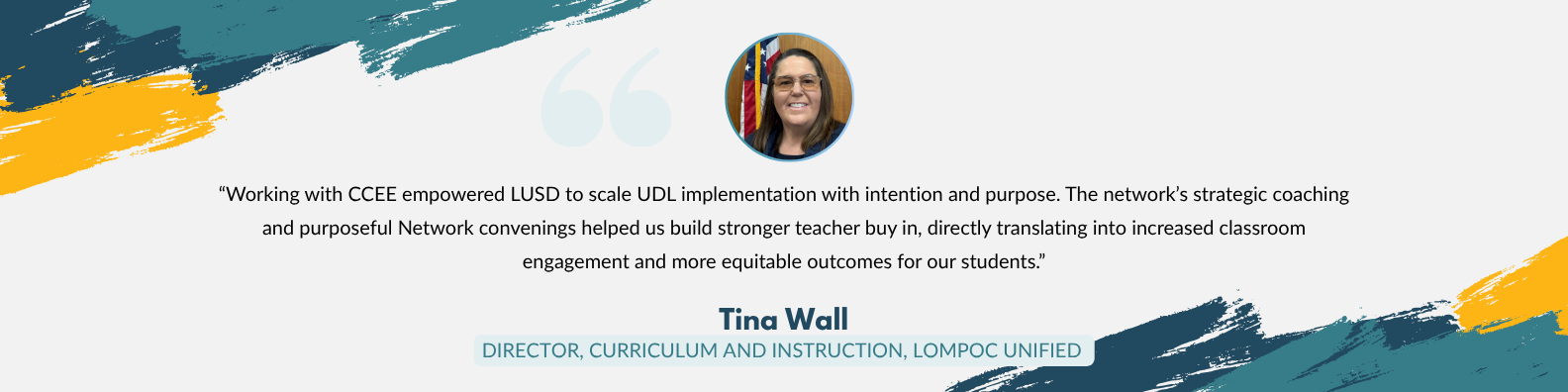
“Our objective was clear: to successfully implement Universal Design for Learning at scale, empowering over 500 educators. The shared expertise of the network helped us identify hidden barriers and build a data-informed systems approach to ensure our UDL implementation thrives.”
Creating Space to Reflect and Learn
For LUSD, one of the most valuable aspects of participating in the network has been having dedicated time to reflect on its implementation.
Guiding questions from CCEE helped district leaders look more closely at their progress and consider where adjustments were needed. Network convenings also created opportunities to learn from peer districts and bring new ideas back to Lompoc.
One on one coaching with CCEE and Open Access provided another layer of support, helping the district stay focused on its action items, communication strategies, and overall direction.
Throughout the process, Lompoc also focused on building capacity from within. The district began with early adopters, developed teacher leaders, and provided ongoing professional learning and coaching as the work expanded. This approach helped create local ownership rather than treating UDL as a separate initiative.
Slowing Down to Strengthen the Work
One of LUSD’s most important shifts was recognizing that scaling UDL did not necessarily mean moving faster.
Instead, the district intentionally slowed its implementation to give educators more time to examine classroom data and reflect on their practice. This helped LUSD move away from a one size fits all approach to professional learning and develop opportunities that better reflected the priorities of individual school sites.
Student perception data also became an important part of the process. By considering student feedback alongside educator reflection, district leaders gained a more complete picture of what was happening across schools and could use that information to guide future decisions.
Looking at Progress from Multiple Angles
LUSD is using several measures to understand how implementation is progressing.
One early indicator is participation in professional learning. While attendance has historically declined after the district’s first professional development day, participation remained considerably stronger throughout 2025 to 2026. Attendance increased from 69.8% to 85% on the second professional development day and from 73.6% to 87.3% on the third.
The district is also looking at broader student and staff indicators. Compared with the previous school year, LUSD reported:
- A 2.6% increase in staff attendance during instructional days
- A 5% increase in students with disabilities spending 80% or more of their day in general education classrooms
- A 2.5% increase in student attendance, with increases across every significant subgroup
- An 18% decrease in referrals for classroom concerns
These measures are influenced by many factors across a school system, but they provide LUSD with important information to consider as the district continues to monitor and refine its UDL implementation.
Building Ownership Across the System
Open Access observed that one of Lompoc’s strengths has been the way leaders at multiple levels have taken ownership of the work. District leaders, site leaders, and teacher leaders each have a role in supporting implementation, creating greater consistency as UDL expands across the system.
“Throughout Lompoc Unified’s UDL journey, leaders owned the work at every level. UDL wasn’t treated as an isolated initiative; district leaders, site leaders, and teacher leaders each had clear roles and served as champions for the work. Their shared commitment to administrator learning, coaching, walkthroughs, and site based ownership helped create consistency and sustain UDL implementation across the system.”
Laurie Balsano Wright
Director, Facilitated Improvement and Support
Educational Innovation and Support
Open Access
A Lesson for Other LEAs
Lompoc’s experience highlights an important lesson for other districts working to implement UDL at scale. Sustainable implementation is not simply about providing more training. It requires time to reflect, consistent communication, opportunities to learn from others, and a willingness to adjust based on what the data and people closest to the work are saying.
It also requires building the capacity of the people who will carry the work forward. By developing teacher leaders, investing in administrator learning, using coaching and walkthroughs, and giving individual sites ownership of implementation, LUSD is creating structures that can help sustain the work over time.
Resources to Explore
For educators and leaders interested in exploring UDL or strengthening their own implementation, these resources can help support the work:
- CCEE Student Perception Survey: A resource for incorporating student voice and experience into implementation and continuous improvement.
- CCEE UDL Data Toolkit: A resource designed to help teams examine UDL related data, identify patterns, and use evidence to guide implementation and continuous improvement.
- CCEE UDL Journey Guide: A practical guide that helps LEAs reflect on where they are in their UDL journey, identify next steps, and plan for sustainable implementation over time.
- CAST UDL Guidelines: A foundational resource for understanding and applying the UDL framework.
- CCEE Student Perception Survey: A resource for incorporating student voice and experience into implementation and continuous improvement.
- Open Access UDL Lesson Planning Toolkit: A practical resource designed to help educators reflect on lesson design and identify opportunities to strengthen UDL practices.
- Open Access Walkthrough Tool: UDL Evidence Form: A resource for observing learning environments, reflecting on current practices, and identifying opportunities for continued growth.
- Lompoc CCEE Open Door Session: An opportunity to learn more about Lompoc’s implementation journey and its approach to developing internal capacity, teacher leadership, professional learning, coaching, and gradual scaling.