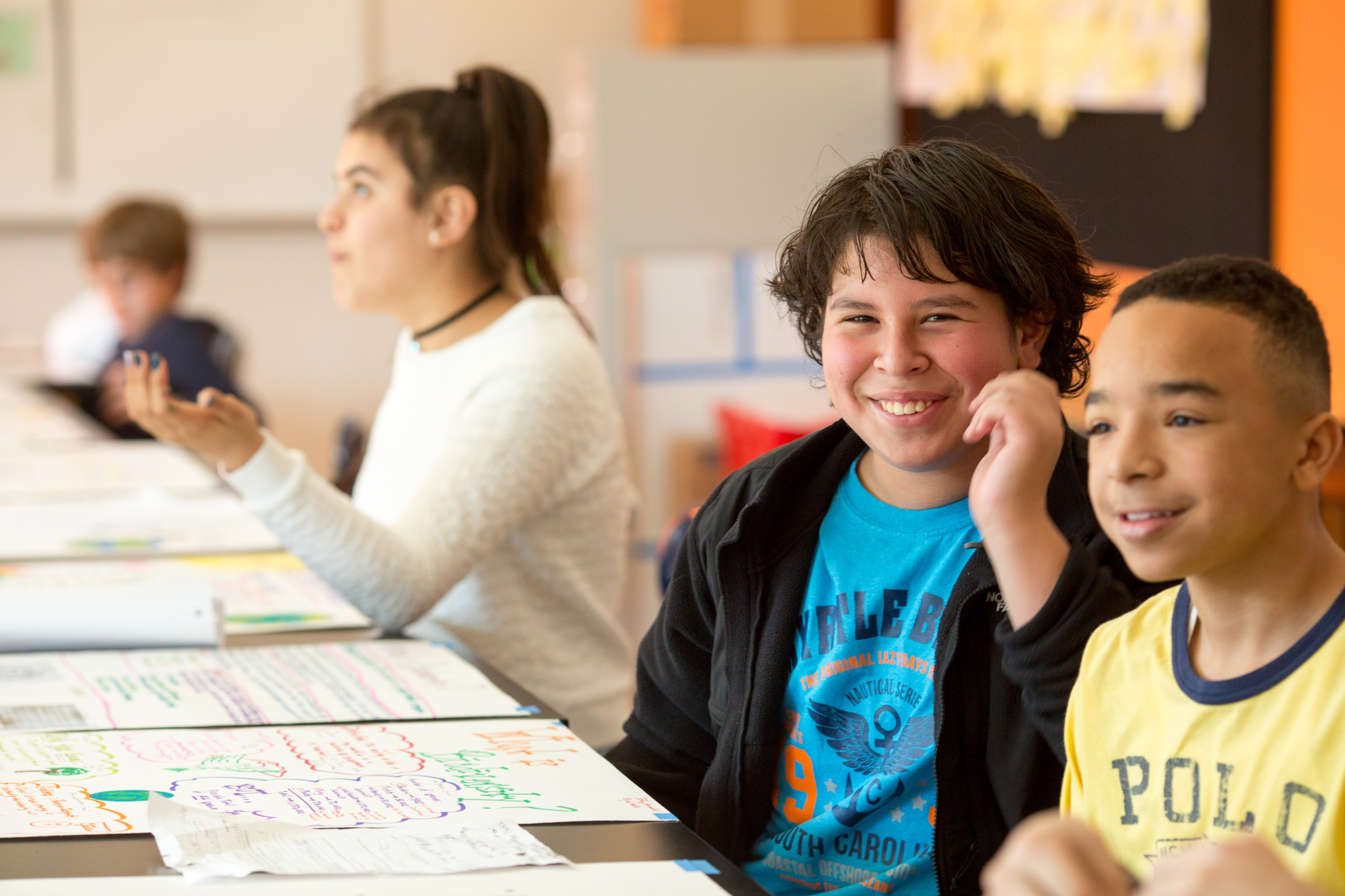
Year-Round Learning – The Time Has Come

Over the decades, there’s been much commentary about the downsides of our school calendar, which was designed to accommodate a farming economy. While this calendar has clearly persisted far beyond its practical application, old habits die hard, especially when so much of American life has revolved around school breaks. Amusement parks, vacation destinations, and other industries have been built around the summer vacation, and many families as well as educators have become very attached to this ritual.

However, for just as many families, and particularly those struggling financially who don’t have the luxury of long vacations or time off from work, summer paints a very different picture. Rather than attending camp and going on vacation, the children of these families are left with little to do and often suffer from what we’ve coined “summer slide”. Research has shown that summer slide is cumulative, so children who miss out on structured learning opportunities summer after summer are at far greater risk of falling behind, of not graduating, and missing key experiences and relationships that lead to college and career paths.

With all we know from both research and experience, why do we consider learning as something that happens just between September and June or between 8am and 3pm? Children are learning all the time—in school and out of school. Our expanded learning and youth development sectors have worked very hard to fill those learning, enrichment, and relationship gaps that children living in poverty experience after school, during winter and spring breaks, and over the long summer. But these out of school programs and opportunities aren’t available to every child in every community, creating one of the biggest and most consequential inequities in our education system.

With unprecedented state and federal investments for expanded learning coming to schools and communities, and multiple years in which to spend, let’s stop looking at the school day and afterschool, school year and summer, as such distinct and disconnected blocks of time. Let’s use this summer as a launching pad for a different approach. For example, utilize new summer program approaches and partnerships to inform school year activities; include afterschool partners in early planning for next summer; and provide opportunities for blended professional development for teachers, school staff, and expanded learning partners so all are grounded with the information and skills they need to support children, all day and all year.

There are many examples to look to, tools to access, and proven practices that should be leveraged as school districts tackle the important work of growing expanded learning opportunities for students. Be sure visit our Summer Technical Assistance Hub to be connected to expert support with planning, program design and operation, partnerships, assessment and more. Want to share this with your network? Click here for a flyer!

AUTHOR

Jennifer Peck, President and CEO, Partnership for Children and Youth (PCY)
Closed Position: Senior Advisor

DESCRIPTION

Under the direction of the Executive Director and Deputy Executive Director, the position of Senior Advisor within the California Collaborative for Educational Excellence (CCEE) provides planning and organizational leadership of the operations, activities, educational services, and support functions of the California Collaborative for Educational Excellence (CCEE). The Senior Advisor serves as the main strategist for the agency around key areas of focus or initiatives as identified by their areas of expertise and experience. The Senior Advisor will be responsible for the development, implementation, and evaluation of activities to support these identified areas of focus. The Senior Advisor will serve as part of CCEE’s Executive Team to set clear direction for CCEE, provide regular updates to CCEE’s Governing Board, and act as a representative of the agency in relevant contexts. The Senior Advisor reports to the Deputy Executive Director.

APPLY

LAUNCH EDJOIN 

Update Regarding Submission Review for the Professional Learning RFP

DESCRIPTION

In accordance with the Addendum issued on February 18, 2021, the deadline for Proposals to be submitted in response to the Professional Learning RFP, for consideration for the 2020-2021 fiscal year, was April 15, 2021. Proposals may be submitted after April 15, 2021, and, at its discretion, CCEE may review those Proposals as needed for this RFP or future professional learning service needs, which work may commence after the 2020-2021 fiscal year. Proposals that are submitted after April 15, 2021, must still adhere to all other requirements of the Professional Learning RFP and Addendum. Any Proposals submitted following this deadline will be reviewed for the 2021-2022 fiscal year, which runs from July 1, 2021, through June 30, 2022.

All inquiries or requests for additional information should be directed in writing to the CCEE Contact, Kashani Daniels ([email protected]). CCEE will make every effort to respond, but any failure to delay in responding shall not excuse a Respondent’s failure to comply with any requirements for submission set forth in the Professional Learning RFP or this Addendum.  Respondents are responsible for and will be presumed to have reviewed the Questions and Clarifications documents posted and updated frequently on the CCEE website regarding this RFP and Addendum, which can be located here.

REFERENCES

LAUNCH PROFESIONAL LEARNING RFP WEBPAGE 

Connecting New Learning to Direct Implementation

A year with COVID-19 has taught us many lessons and surfaced many challenges, including the way we have approached professional learning. Gone are the days of one-and-done professional learning events. We now know that providing educators with a list of workshops to choose from simply based on “what sounds good” can lead to disconnected, single event learning opportunities with little impact on the school organization’s targeted key results for student success.

The Supporting Inclusive Practices (SIP) project, as a collaborative statewide effort amongst team members from the Riverside County Office of Education and El Dorado County Office of Education, provides, in part, technical assistance rooted in intentional re/design of systems and supports at all levels to connect new learning to direct implementation. The most requested support is with implementation of universal design for learning (UDL) as a framework to create flexible learning environments that maximize choice, so that each and every student can learn in the way they learn best

The Arcadia Unified School District in Los Angeles County is among the growing number of districts implementing UDL in our state. Knowing a one- or two-day UDL workshop would not suffice, Dr. Katherine Mahoney, Director of Special Education, offered this of their intentional design across several years: “With the support of the SIP team, the time AUSD students with disabilities spent in general education settings increased by more than 28% over five years. In 2019 the academic performance for students with disabilities increased in English Language Arts by 13.4% and in Math by 8.4% on the Smarter Balanced Assessment.”

The Poway Unified School District in San Diego County is on this same path for UDL implementation.  Megan Gross, Teacher on Special Assignment, shared, “In 2021 we partnered with SIP to begin a professional learning series focused on UDL that will continue through the 2022 school year. Our goal is to provide 31 schools (elementary and middle) the instructional design tools to increase access to general education for all students.”  

California’s educators are moving beyond one-off workshops after seeing sustained, measurable outcomes for all students with ongoing coaching and scaling of UDL over time. It is this work that is the heart of SIP! Learn more about UDL on the SIP website, which offers access to archived resources and free professional learning events.

AUTHOR

Kristin Brooks, Ed.D.,
Executive Director,
Supporting Inclusive Practices (SIP)

Flexibly Designing Instruction to Remove Barriers and Attend to Learner Variability

After a year of pivoting, it may well be time for a stretch. Whatever instructional calisthenics educators encounter in 2021, flexibility will be key. As districts hasten to complete learning acceleration plans to secure Assembly Bill 86 or American Rescue Plan funding, it is important to remember the role that intentional planning has in ensuring inclusion for the success of all students. The California Coalition for Inclusive Literacy (CCIL), led by Universal Design for Learning experts at CAST, supports districts at a time when “the myth of average” will not be more apparent.

As students return to school sites, they may come having experienced trauma, loss, triumph, growth, or all of the above. CCIL, a partnership between the California Department of Education (CDE), CCEE, and five county offices of education, provides professional learning to help districts and educators anticipate learner variability and proactively design instruction to minimize barriers. This three-year initiative, funded by the Special Education Educator Workforce Investment Grant, focuses on practical  implementation of UDL to maximize choice and provide multiple means of access to content for students during instruction.

Through a tiered service model of universal, targeted, and intensive technical assistance, CCIL fosters inclusive educational and literacy practices in both general and special educational settings. 

Universal Supports: CCIL’s universal supports ensure that educators across California can acquire the essential knowledge to provide access to grade-level content by supporting literacy within general education settings. Resources such as the Learning Designed instructional platform, free webinars, podcasts, graphic organizers, and lesson planning templates will all increase the capacity of your teachers and paraprofessionals to provide supports for all students, but especially to English learners and students with disabilities.

Targeted Supports: Teams of educators from districts and schools will engage in cycles of professional learning activities throughout the school year, including county-led training days, professional learning communities, and personalized workshops. Deeper work includes collaborative classroom observation protocols, sharing of demonstration lessons, resource creation using Lesson Design Studios, and opportunities to earn credentials through self-paced learning modules.

Intensive Supports: COE/SELPA coaches in five counties will spend three years diving deeply into CAST’s model of universally designed inclusive literacy development. These coaches will learn to facilitate innovative professional learning opportunities that build the internal capacity of COEs to scale and sustain their work across districts and into other counties.

“When a flower doesn’t bloom, you fix the environment in which it grows, not the flower.”

 – Alexander den Heijer –

AUTHOR

Elise Yerkey,
Implementation Specialist,
CAST

RESOURCES

Designing for Literacy Development in the Hybrid Classroom (Webinar Series)

Closed Position: Senior Specialist, Executive Projects

DESCRIPTION

Reporting directly to the Deputy Executive Director (DED), the Senior Specialist, Executive Projects (SS) is a hands-on point-person who expertly and independently provides executive level, program, project and administrative support. The SS works independently on projects, from conception to completion, and must be able to work under pressure at times to handle a wide variety of activities and confidential matters with discretion. The SS is responsible for using discretion and judgment while proactively providing scheduling, travel, project tracking, office management, event planning, meetings management, and general support within a dynamic environment that is mission-driven, results-driven, and community oriented. A successful candidate exercises good judgment in a variety of situations, demonstrates strong written and verbal communication, engages administrative and organizational skills, and maintains a realistic balance among multiple priorities with general oversight of the DED. Under the general direction of the DED, supports a variety of programs and initiatives for the California Collaborative for Educational Excellence (CCEE).

APPLY

LAUNCH EDJOIN 

Statewide Dashboard

DESCRIPTION

On March 5, 2021, Governor Gavin Newsom signed Assembly Bill 86, which updated the requirements of the January 14 order issued by the California Department of Public Health (CDPH), and subsequently requires every educational agency (i.e., school district, county office of education, and charter school) and private school to submit information about how instruction is being provided. Updates in the 2021-22 education omnibus budget trailer bill, pursuant to Education Code 32091, identified data elements for SY 2021-22.

LAUNCH INSTRUCTIONAL MODES SURVEY 

CA SAFE SCHOOLS FOR ALL HUB 

REGISTRATION PROCESS

CCEE hosted a training to support schools with the data collection requirements and submission process for the statewide Instructional Modes Survey. To register as a point of contact for your school, please refer to this document, which provides an overview of the registration process. Please note that this is for new points of contact only.

OVERVIEW OF REGISTRATION PROCESS 

LAUNCH SLIDES 

QUESTIONS?

Please contact the Help Desk for any assistance with the data submission process or check the FAQ sheet for responses to our most commonly asked questions. Questions submitted to the Help Desk will be responded to within the same business day.LAUNCH HELP DESK FREQUENTLY ASKED QUESTIONS (FAQS) 

Closed Position: Senior Research Specialist

DESCRIPTION

Under the direction of the Assistant Director, Business Operations and Strategic Engagement for the CCEE, the position of Senior Specialist, Research for the CCEE provides research and program evaluation support for various initiatives managed by the CCEE. The Senior Specialist, Research leads various aspects of research, including developing data collection instruments; collecting, cleaning, and managing large data sets, conducting complex analyses, preparing reports and presentations based on results, and making recommendations across a variety of internal and external projects. In addition, the Senior Specialist, Research schedules, coordinates, and manages on-site research activities; establishes and maintains positive relationships with external partners and stakeholders; and trains other personnel as appropriate.

APPLY

LAUNCH EDJOIN 

Leveraging Relationships to Reengage Students

With the passage of Assembly Bill 86, school districts will once again feel the pressure to speedily match students’ needs with the appropriate level of intervention and learning supports to accelerate learning. Although the question of how schools will address the large-scale learning acceleration of students is complex, we know that students need to first feel safe and secure to learn. This will require an initial assessment—in an intentional and formative manner—of the personal well-being of not only the students, but also the adults. In this past year, students and adults alike have been “battered by difficult emotions stemming from not only the pandemic, but also the economic recession and ongoing civil rights protests” (Prothero, 2021). Data on student and adult experiences will serve as the ultimate truth teller to help understand where they are and how we can move forward in addressing the necessary protective factors to engage our students academically. 

CCEE invited Dr. Peter Senge, co-founder of the Center for Systems Awareness and author of The Fifth Discipline, to be a part of the Leading Forward 2021 initiative. In his keynote session, Dr. Senge shared a conversation he had with a group of educators about the scar tissue left on our learners and adults after the pandemic.

“They talked about scar tissue. It’s one of the first images that was used. The damage has been done, and healing is actually more important in a way than learning in the traditional sense. Without healing, without recognizing and attending to the deep social, emotional traumas that students have gone through, we can think we’re focusing on learning and we can think we’re making up ground, but we won’t make much.”

As schools prepare to reopen, we must be prepared to address the reengagement of students and what that means in our current context. This begins with building or rebuilding staff-student, staff-staff, student-student, and staff-family relationships, which are fundamental in supporting the social, emotional, and academic needs of students. Consider the following strategies to strengthen these relationships:

Staff-student: Map out relationships so each student is assigned a staff member who develops and maintains a relationship with the student through regular scheduled check-ins. Greet students at the door, organize fishbowl discussions, and design activities for students to have fun and show school spirit, focusing on strategies that strengthen relationships and build trust. 

Staff-staff: While resources and attention, appropriately, are front and center in supporting students, less focus is paid to assessing and addressing the mental health of educators who have also struggled to find balance and safety during the pandemic. Conscious efforts should be made to leverage staff-staff relationships by promoting relationship-building and peer-to-peer support through “wellness committees,” mentors, professional counselors, social workers, school psychologists, or other trained professionals.

Student-student: Facilitate the process of creating a shared agreement for classroom norms, set the expectation that every voice matters, and provide opportunities for students to develop individual relationships and build a class community (e.g., “mix and mingle” activities, “glows and grows,” team projects) – virtually and face-to-face (as deemed safe).

Staff-family: Staff-family relationships have probably never been more important. Using culturally and linguistically responsive approaches, regularly communicate with families to schedule individual check-ins and distribute climate and culture surveys. Listen to what worked and didn’t work for them during the pandemic and use these opportunities to understand the needs of their children. Additional trauma-informed trainings or resources can support families in approaching difficult conversations with their children to help them cope with changes and prepare for the transition back to school.

As schools bring more students back for in-person instruction, we must create psychologically safe learning environments to accelerate learning, while advancing equity for our vulnerable student groups. The March edition of the CCEE newsletter will feature tools, strategies, and resources focused on reengaging students and building relationships, to ensure we are addressing the whole child. 

AUTHOR

Tom Armelino, CCEE Executive Director

School Re-entry and School-based Mental Health Supports

As we prepare to welcome students back to campus, one thing is abundantly clear – status quo will never be the same. Returning students will need unprecedented access to mental health supports to overcome trauma stemming from the COVID-19 crisis, social injustice, wildfires, and a multitude of other experiences. Schools must prioritize the psychological safety of all students, families, and educators as never before. Left untreated, trauma, anxiety, and depression will impair students’ ability to engage in learning, leading to greater academic skills gaps and exponentially increased social-emotional/behavioral needs. 

The research is clear—early intervention yields positive outcomes. Key to unlocking student success are credentialed school-based mental health professionals (school psychologists, counselors, and social workers) who play an integral role in the early identification of mental health issues. These highly trained professionals must be included in each phase of the school reopening plan, as they collaboratively support the social-emotional well-being of students, families, and educators. Within the Multi-Tiered System of Support framework, they implement culturally sensitive, trauma-informed supports for the whole child by: helping teachers embed social-emotional learning into the curriculum; helping students reconnect through back-to-school events, peer buddies, looping, and more; developing and communicating re-entry plansexamining infrastructure to conduct universal screening and informal check-ins with students; and managing a referral system for students at higher risk. Administrators—now is the time to embrace your Pupil Personnel Services (PPS) team as mental health providers. 

AUTHOR

By Jeannine Topalian, Psy.D., LEP#3365, CASP President