Achieving Equity and Excellence

DESCRIPTION

This three-part series outlines how educational leaders can empower students, teachers, and administrators to make dramatic improvements in student learning, behavior, and attendance. In these sessions, participants will learn about the core competencies of “Equity and Excellence Schools” and will explore equitable teaching practices to meet the needs of diverse learners.

PRESENTER

Dr. Douglas Reeves, Founder, Creative Leadership Solutions

WHAT EDUCATORS AND SCHOOL LEADERS CAN DO NOW TO ACCELERATE LEARNING

Many schools are making decisive actions to accelerate learning, improve assessments, increase attendance, and better engage students. This session will examine effective teacher and leadership actions that have the greatest impact on student achievement. 

THE NEW MODEL OF CHANGE LEADERSHIP

The global pandemic will continue to affect schools long after schools re-open. Changes will be required in schedules, student support, faculty support, state standards, and assessments – and all of these changes will be taking place at a time when educators and school leaders are desperately seeking a return to normal. This session will introduce the new model of change leadership, which requires leaders to try, test, and improve new strategies within very short periods of time. 

FEARLESS SCHOOLS

The global pandemic has left in its wake traumatized students, families, and educators, and fear has been the dominant emotion. The essence of fearless schools is the building of psychologically safe environments where students and educators can learn together, make mistakes with transparency, learn from those mistakes, and engage in consistent innovation, experimentation, and learning. This session will explore how fearless schools can meet these psychological needs and serve as the foundation for resilience for the students and communities they serve.

RESOURCE TYPE

Professional Learning

TYPE OF AUDIENCE

Site Administrator / Instructional Coach, Systems Leadership, Teacher

TOPIC AREA

Continuous Improvement, Equity, Governance

KEYWORDS

Leadership

Summer Game Plan Series

DESCRIPTION

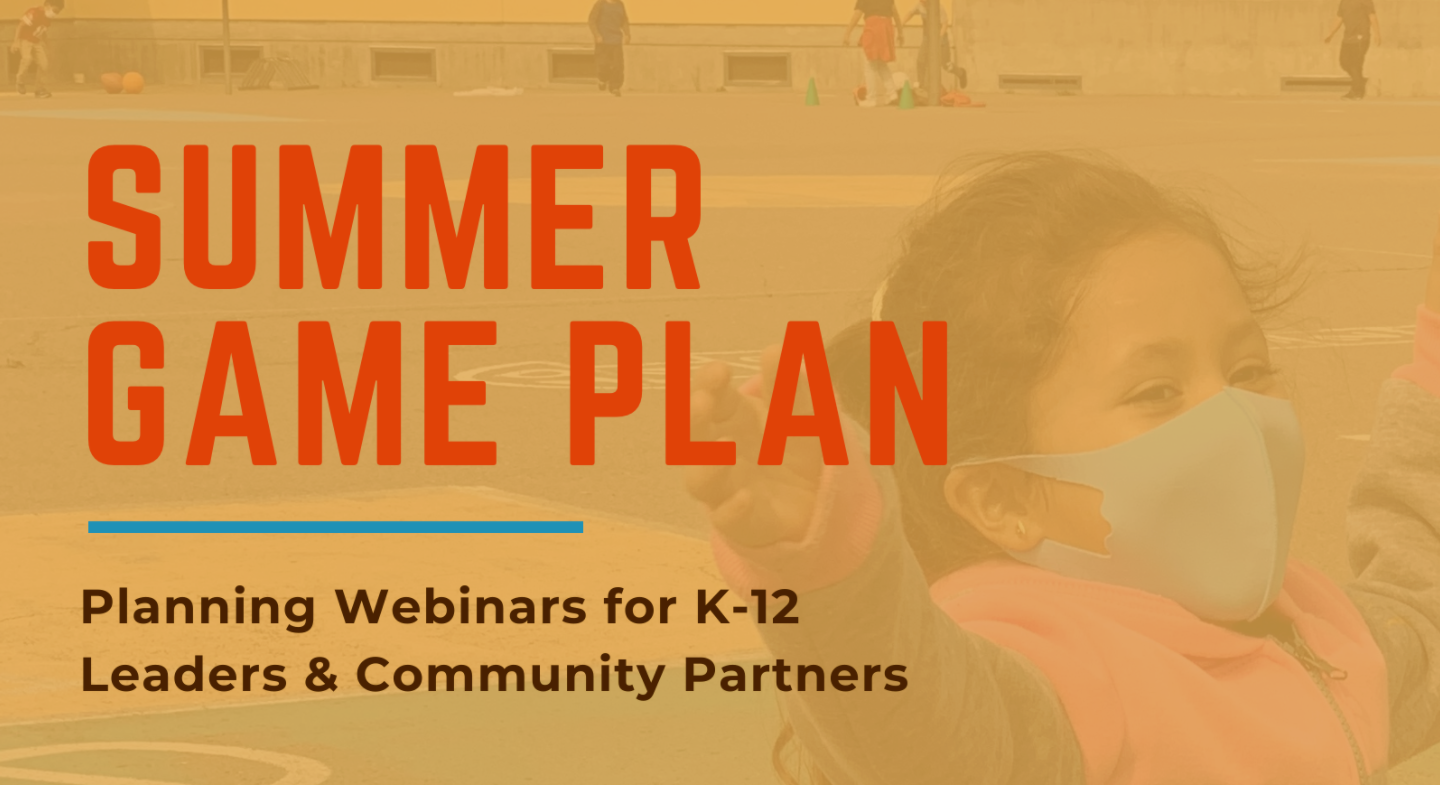
This summer is more important than ever to help students begin to recover from the learning loss, isolation, and trauma of the past year. Designed for K-12 administrators, educators, and community partners, the Summer Game Plan series provides strategies to navigate challenges in planning summer learning programs, resources to aid your planning, and the latest research and guidance from nationally recognized experts.

OFFERED IN COLLABORATION WITH

Partnership for Children & Youth

SUMMER RESEARCH, PRACTICE, & FUNDING: FOUNDATIONS FOR SUMMER PLANNING

This webinar covers the latest national research on strategies and practices that contribute to impactful summer programs, and updates on state and federal funding to help inform local planning.

CREATIVE SOLUTIONS FOR SUMMER STAFFING

This webinar explores a range of creative staffing models that ensure high-quality staffing while meeting other goals, such as developing future school leaders, providing more planning and collaboration time, and expanding experience operating blended staffing models.

CREATING ENGAGING SUMMER LEARNING OPPORTUNITIES FOR HIGH-SCHOOL YOUTH

This webinar provides examples of enrichment programs that provide opportunities for high school youth to engage in real-world experiences, connect with mentors, earn income and/or school credit, and build leadership and collaboration skills.

PARTNERING WITH HIGHER EDUCATION AND PRE-SERVICE TEACHERS

Summer learning provides a unique training ground and flexible learning space for teacher preparation and pre-service teachers. This webinar provides examples of how school districts can leverage higher education partners to recruit new teachers and teachers candidates from existing teacher pipeline programs.

MEETING THE NEEDS OF EARLY LEARNERS THIS SUMMER

Many families chose not to enroll their children in pre-kindergarten and kindergarten in the 2020-21 school year for a variety of reasons, including concerns that distance learning is not well-suited for younger students. This webinar explores how summer programs can meet the needs of younger learners and their families, especially those minimally engaged in school this past year.

SUMMER PROGRAM MARKETING, ENROLLMENT, AND ENGAGEMENT

Summer attendance and outreach is always difficult, especially among underserved students, and is likely to be even more challenging after a year of distance learning. This webinar explores best practices for creatively and strategically coordinating outreach to families and students about the benefits and opportunities of participation in summer learning programs.

RESOURCE TYPE

Media, Professional Learning

TYPE OF AUDIENCE

Site Administrator / Instructional Coach, Systems Leadership, Teacher

TOPIC AREA

Continuous Improvement, Equity, LCAP

KEYWORDS

Leading Forward, Summer Learning

CAAASA Field Guides: Lifting Our Voices

DESCRIPTION

Now is a perfect time for all of us to take time for introspection where we identify, name, and document our experiences of the past 12 months, and harness the power of those lessons learned. The experiences and reflections of our students, teachers, parents, and families of color can serve as guides for how we can better serve our students in the coming months when they return to their classrooms on campus. The Lifting our Voices Field Guides are designed to make that readjustment both possible and successful by capitalizing on the lessons learned in 2020 and 2021.

DEVELOPED IN PARTNERSHIP WITH

California Association of African-American Superintendents & Administrators (CAAASA)

FIELD GUIDE 1: TRANSITIONING BACK TO SCHOOL WITH A FOCUS ON RELATIONSHIPS

Field Guide #1: Transitioning Back to School with a Focus on Relationships examines the costs of distance learning, the lessons learned, and the opportunities for growth.

FIELD GUIDE 2: LEARNING AND HEALING TOGETHER

Field Guide #2: Learning and Healing Together explores the relationship between emotions and learning, including the considerable stressors experienced by students, families, and educators during the COVID-19 pandemic.

FIELD GUIDE 3: SCHOOL ENGAGEMENT: IN-PERSON AND HYBRID LEARNING

Field Guide #3: School Re-Engagement: In-Person and Hybrid Learning lifts the voices of education leaders, researchers, teachers, students, parents, and even a grandparent, all focused on the challenges of re-engaging in education.

FIELD GUIDE 4: PLANNING FORWARD WITH CULTURAL RELEVANCE IN THE CLASSROOM

In Field Guide #4: Planning Forward with Cultural Relevance in the Classroom, you will hear from education leaders, researchers, teachers, and families about the value of embracing the vibrant, diverse cultures of our communities in our classrooms.

FIELD GUIDE 5: BACK-TO-SCHOOL AND THE YEAR AHEAD: INTEGRATING EMPATHY, COMPASSION AND RESTORATIVE JUSTICE IN OUR SCHOOLS.

In Field Guide #5: Back-to-School and the Year Ahead: Integrating Empathy, Compassion and Restorative Justice in Our Schools, you will hear from education leaders, researchers, teachers, and families about the need for culturally responsive approaches to instruction, discipline, and social emotional well-being.

FIELD GUIDE 6: ENHANCING PARENT ENGAGEMENT FOR STUDENT SUCCESS

In Field Guide #6: Enhancing Parent Engagement for Student Success, you will hear from education leaders, researchers, teachers, and families about the importance of family engagement and strong parent-school partnerships in order to address the needs of the whole child.

FIELD GUIDE 7: SCHOOL RE-ORIENTATION FOR POST-COVID LEARNING

In Field Guide #7: School Re-orientation for Post-COVID Learning, we explore one of the most important challenges facing secondary students, which is providing a pathway to success for middle and high school students who have been failed by our traditional educational system, rather than the conventional “safety nets” that rescued students in relatively small numbers.

FIELD GUIDE 8: UNDERSTANDING THE MOST CRITICAL NEEDS OF TODAY’S AFRICAN AMERICAN STUDENTS (AND CHILDREN FROM OTHER COMMUNITIES OF COLOR)

In Field Guide #8: Understanding the Most Critical Needs of Today’s African American Students (and Children from Other Communities of Color), you will hear from education leaders, researchers, teachers, and families about how educators can best meet the needs of African American students and other students of color given the historical and contemporary challenges they face.

FIELD GUIDE 9: PREPARING AFRICAN AMERICAN (AND OTHER STUDENTS OF COLOR) FOR COLLEGE

In Field Guide #9: Preparing African American (and Other Students of Color) for College, we explore how educators and parents can help prepare African American students and students of color for success in college.

FIELD GUIDE 10: Equity as a Centerpiece in Education

In Field Guide #10: Equity as a Centerpiece in Education, we will help you understand educational inequities and the negative impacts they continue to have on Students of colors.

Field Guide 11: The Principal as the Equity Leader

In Field Guide #11: The Principal as the Equity Leader, we will help you understand how to remove contemporary obstacles to educational equity to assure that every child has an opportunity to maximize his/her potential.

Field Guide 12: Rebounding from Unfinished Teaching and Learning

In Field Guide #12: Rebounding from Unfinished Teaching and Learning (the “Learning Loss,” we aim to guide school district decision-making and resource allocations in such a manner that all students and especially African American students and students from other communities of color will indeed rebound rapidly from the learning loss that resulted from the unprecedented COVID-19 pandemic.

RESOURCE TYPE

Professional Learning

TYPE OF AUDIENCE

Parent, Site Administrator / Instructional Coach, Systems Leadership, Teacher

TOPIC AREA

Equity, Social-Emotional Well-being

KEYWORDS

CAAASA

Assessment for Learning in Extraordinary Times

DESCRIPTION

How do you know if students are with you at the beginning, middle, and end of a lesson? Can formative assessment offer a key to better teaching and learning during instruction? In this three-part series, participants will learn how to blend different formative assessment moves in the classroom, with intention and care for all students, to help make better instructional decisions. These sessions will explore the following seven research-based, high-leverage formative assessment moves: priming, posing, pausing, probing, bouncing, tagging, and binning.

PRESENTERS

Dr. Brent Duckor, President, Validity Partners

Dr. Carrie Holmberg, Associate, Validity Partners

THE POWER OF POSING, PAUSING, AND PROBING TO ADVANCE DEEPER LEARNING

This session introduces the first three of seven formative assessment moves: posing, pausing, and probing. Participants will learn how and when to ask questions, encourage student responses, and deepen discussions in online, hybrid, and in-person settings.

THE POWER OF BOUNCING, TAGGING, AND BINNING FOR FEEDBACK TO ADVANCE DEEPER LEARNING

This session explores how bouncing, tagging, and binning can be employed in online, hybrid, and in-person settings. Participants will learn how to sample student responses to broaden participation, describe and record students responses without judgement, and interpret student responses with a wide range of tools.

FORMATIVE ASSESSMENT MOVES TO UNCOVER ACADEMIC LANGUAGE DEMANDS AND SUPPORT ENGLISH LEARNERS

To ensure equity in our formative assessment practices, we must think carefully about academic language demands for everyone including our EL students. In this session, we explore the power of the seven formative assessment moves framework to increase students’ academic language use and production in online, hybrid, and in-person settings.

RESOURCE TYPE

Professional Learning

TYPE OF AUDIENCE

Site Administrator / Instructional Coach, Systems Leadership, Teacher

TOPIC AREA

Continuous Improvement, Equity, LCAP

KEYWORDS

Formative Assessment

Developing & Implementing Balanced Assessment Systems

DESCRIPTION

The call for balanced assessment systems resulted from a recognition that most assessments poorly served a primary purpose of assessment—improving learning and instruction. Educators understand that large-scale summative tests are far too distal from instruction, at the wrong grain size, and administered at the wrong time of year to make a difference in their daily practice. Further, many district leaders turned to commercially available district assessments that do not clearly link to other levels of the system (Perie, Marion, & Gong, 2009). Therefore, the calls to balance assessment systems—actually rebalance these systems—were motivated by the desire to enhance the utility of assessments for improving learning and instruction as well as for monitoring, accountability, and evaluation. 

This series will help school and district leaders understand the value proposition for balanced assessment systems, key design features of such systems, the challenges to implementation, and benefits from practical suggestions for overcoming these challenges.

FACILITATED BY
Scott Marion, Ph.D., Executive Director, Center for Assessment

INTRODUCTION TO BALANCED SYSTEMS OF ASSESSMENT

This session presents the rationale for balanced assessment systems, articulates the intended uses of assessment results, and introduces the criteria for judging the balance of an assessment system. It concludes with a discussion about the barriers to implementing balanced assessment systems.

THE CRITICAL ROLE OF CURRICULUM & LEARNING PROGRESSIONS IN BALANCING ASSESSMENT SYSTEMS

This session focuses on the most important criterion for balancing assessment systems—coherence—and how it can be supported with high-quality curriculum and learning progressions. Curriculum and learning progressions provide a foundation for designing assessments and assessment systems. Even more importantly, they provide an interpretative lens to understand the instructional power of assessment results. This session highlights features that distinguish high-quality curriculum and learning progressions from lower quality processes and products.

THE COMPONENTS OF A BALANCED ASSESSMENT SYSTEM

There is an unfortunate “urban legend” about balanced assessment systems. Many often think that a balanced assessment system includes summative, interim, and formative components. This session looks at key features of various types of assessments to help participants learn how to evaluate components of an assessment system in light of its intended purpose and use. The session will discuss what it takes for assessments to be instructionally useful and will explore the power of curriculum-embedded, unit-based assessments.

THEORIES OF ACTION AS A TOOL FOR DEVELOPING & IMPLEMENTING BALANCED ASSESSMENT SYSTEMS

This session introduces theories of action as a tool for helping district and school leaders identify the problems/issues they are trying to address through the design and implementation of assessment systems. Theories of action provide a comprehensive framework for analysis, evaluation, and continuous improvement. In addition to understanding the usefulness of theories of action, participants will explore several practical tools to help them begin developing theories of action for balanced systems of assessment.

DOES IT QUACK LIKE A DUCK? WOULD I KNOW A BALANCED ASSESSMENT SYSTEM IF I SAW ONE?

This session looks at real examples from the field to help participants understand what developing systems look like in practice. District assessment leaders from various size school districts will share how they’re adapting the theory and practice of developing balanced assessment systems to their contexts. Participants will gain an understanding of the challenges faced by these leaders and hear how they are trying to overcome them.

CAAASA Field Guide 2: Learning and Healing Together

DESCRIPTION

CAAASA Field Guide 2: Learning and Healing Together explores the relationship between emotions and learning, including the considerable stressors experienced by students, families, and educators during the COVID-19 pandemic. Hear from authentic voices in the field, including administrators, teachers, parents, and students, and engage in targeted professional learning.

DEVELOPED IN PARTNERSHIP WITH

California Association of African-American Superintendents and Administrators (CAAASA)

Launch E-Learning

CAAASA Field Guide 2

Description

In Field Guide 2: Learning and Healing Together explores the relationship between emotions and learning, including the considerable stressors experienced by students, families, and educators during the COVID-19 pandemic. Hear from authentic voices in the field, including administrators, teachers, parents, and students, and engage in targeted professional learning.

DEVELOPED IN PARTNERSHIP WITH

California Association of African-American Superintendents & Administrators (CAAASA)

Launch