Hot Topics: Three New Papers, One Timely Opportunity

As the Governor’s budget elevates governance reforms to strengthen coherence and accountability, these new briefs point to practical, evidence informed strategies that can make California’s TK–12 system easier to navigate and more effective for students.

Below are quick takeaways from each paper, and how they connect to the governance changes proposed in the budget.

Statewide System of Support (SSoS) Core Working Group Report: Recommendations

  • Summary: The report presents a forward looking redesign of the statewide support system by clarifying roles, improving how support is determined, and making assistance a true capacity building partnership for districts.
  • What to watch for: A practical next generation support model that turns fragmented help into a coordinated, high impact approach so districts get the right support at the right time.

TK–12 Education Governance in California: Past, Present, and Future

  • Summary: The paper offers a clear governance blueprint that organizes responsibilities around core functions including policy and funding, implementation and capacity building, and evaluation and accountability.
  • What to watch for: A systems design approach that clarifies authority, reduces conflict, speeds decision making, and helps statewide priorities translate into consistent local results.

Effective Governance: Recommendations from the Field

  • Summary: The paper shows what strong local governance looks like in practice, with boards and superintendents aligned around student outcomes, smart oversight, and deep community trust.
  • What to watch for: Local governance as a high leverage solution, where boards have the tools and practices districts need to move faster, stay focused, and sustain improvement even amid state level changes.

These three new papers offer a practical, solutions-oriented roadmap for strengthening California’s TK–12 governance: clarify roles and accountability, improve the quality and targeting of statewide support, and invest in effective local board governance. Read alongside the upcoming Governor’s proposal to streamline oversight and coordination, these recommendations highlight how structural alignment at the state level can translate into clearer support and better outcomes for students locally.

Related Articles:

Curious what we’re up to? Get the newest updates on the CCEE website, events calendar, statewide maps and initiatives.

Hot Topics: LCAP Mid-Year Review February 28 Deadline & What Leaders Need to Decide Now

As the February 28 deadline for the LCAP Mid-Year Update approaches, LEA (county, district, and charter) leadership teams across California are preparing to present required updates on LCAP outcomes, implementation progress, and expenditures as part of a non-consent board agenda item.

While local boards are not required to adopt the mid-year update, the presentation is a critical moment for public transparency, continuous improvement progress, and strategic course-setting for the remainder of the school year.

To support county offices of education, school districts, and charter schools in meeting this requirement with clarity and purpose, the LCAP Monitoring & Evaluation Tracking Tool, developed by the Riverside County Office of Education, offers a practical way to organize mid-year outcome data and track implementation and expenditures aligned to the current year’s LCAP.

Getting Started with the Tool:

  • Tutorial Video: Watch a comprehensive guide to understand how to utilize the tool’s full capabilities.
  • Download the Tool: Access is available directly on our website, allowing leaders to begin tracking and evaluating their LCAP actions to report what is/is not working and why.
  • Example Application: Review practical examples to see how the tool can be effectively applied.
  • Recorded Webinar: Learn from Lake Elsinore USD experiences using the LCAP Mid-Year tool.

In addition, San Diego County Office of Education has curated a comprehensive set of Mid-Year Update resources, including a recorded webinar, presentation slides, legal references, optional templates, and guidance related to Learning Recovery Block Grant (LREBG) considerations for 2025–26.

  • LCAP Mid-Year Resource Page: Access aligned tools, examples, and training to support transparency, decision-making, and continuous improvement at the mid-year point.
  • Recorded Webinar: Supports leaders in understanding mid-year update requirements and using available data to inform transparency and decision-making.
  • Presentation Slides: Review step-by-step guidance on required mid-year outcome, implementation, and expenditure reporting to support clear board presentations.

As February 28 approaches, these resources help LEA leaders strengthen clarity, transparency, and decision-making at the mid-year point.

If you have any questions about CCEE, please visit our website. Stay tuned for LCAP support resources, through our events calendar and the Statewide System of Support Resource Hub.

Hot Topics: Statewide System of Support Core Working Group Report

California has an opportunity to transform its Statewide System of Support into a coherent, learning-focused network that delivers the right help to districts when they need it most.

This new Core Working Group report outlines a hopeful and practical path to strengthen California’s Statewide System of Support so that every district can access high-quality, coordinated assistance focused on student learning. Grounded in the principles of coherence and reciprocal accountability, the paper outlines six major recommendations, including setting a small number of nonnegotiable statewide goals, clarifying authority across state and county agencies, refining how districts are identified for support, and creating an escalation pathway when improvement stalls.

The paper invites policymakers, county offices, and district leaders to act on these recommendations and consider how they can contribute to building a more coherent, responsive support system for all California students.

For additional updates, visit the CCEE website, events calendar, Resource Center, and the Statewide System of Support Website.
Hot Topics: What CCEE is Learning About Deep System and Instructional Recovery

The conversation around pandemic recovery in education has shifted. We’ve moved past the initial frustration of learning loss and entered a more demanding phase: the new normal of sustained, evidence-based intervention that supports the whole child and produces measurable academic improvement. CCEE launched its Intensive Assistance Model (IAM) in 2022–23 to help district and school-site leaders and teacher teams navigate today’s instructional complexity through proven practices that strengthen rigor, coherence, and consistency with a clear focus on improving teaching and learning.

The Architecture of Effective Support

What distinguishes IAM from typical technical assistance is its structural design. The partnership framework connects CCEE, school districts, County Offices of Education, and Solution Tree’s PLC at Work® process through certified associates who provide intensive onsite support rather than periodic consultations. This matters because the gap between knowing what works and implementing what works is where most improvement efforts fail. Teachers attend professional development, return to their classrooms, and gradually revert to previous practices, not from lack of will, but from lack of embedded support. The IAM model addresses this by situating expert coaches within schools for extended engagements, ensuring that the collaborative structures essential to PLC work don’t collapse under the pressure of daily demands.

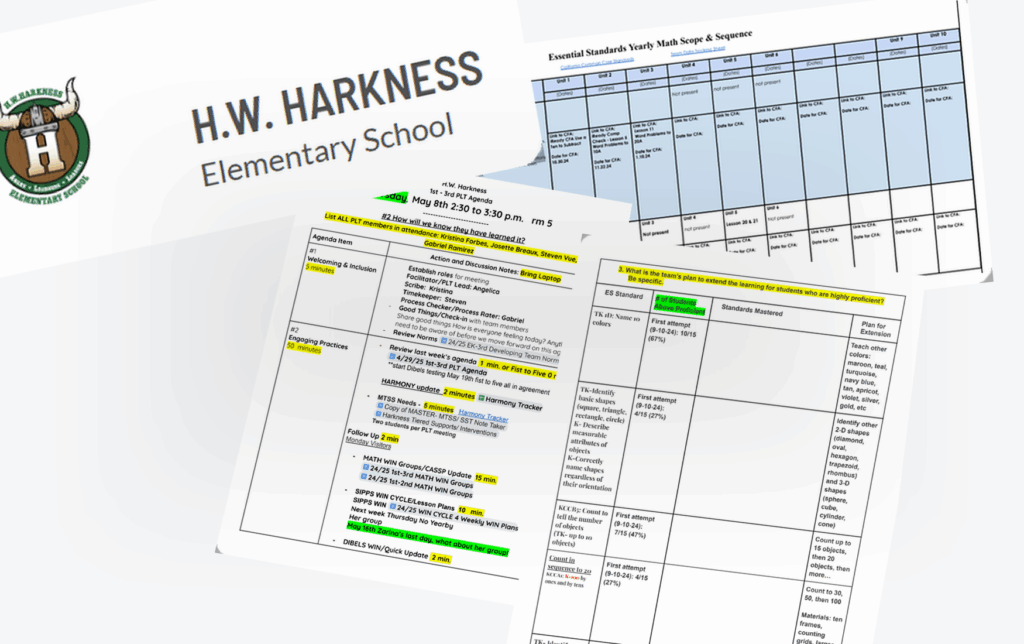
The hard work of H. W. Harkness Elementary School in partnership with Sacramento City Unified School District was recently recognized with the California Promising School designation. This honor reflects meaningful progress in implementing PLC at Work® and marks an important milestone on the path toward becoming a Model PLC at Work school. Promising Practices schools demonstrate a strong foundation for high-functioning professional learning communities and provide at least one year of evidence showing growth in student achievement.

Lessons from Sacramento Unified’s Implementation

Harkness Elementary in Sacramento Unified School District provides a detailed case study of IAM implementation with three dimensions of their work providing insight for educators considering similar approaches.

Monitoring with Intentional Frequency

The school’s approach to monitoring student learning demonstrates how granular attention to assessment yields actionable data. Their sequence begins with Essential Standards selection from California State Standards, followed by unpacking those standards into student-friendly “I CAN” statements that serve both student understanding and teacher clarity about learning targets. The daily informal assessments (exit tickets, fist of five, thumb signals, punch cards) create continuous feedback loops that inform immediate instructional adjustments, while unit assessments and Common Formative Assessments (CFAs) provide structured checkpoints.

The critical detail here is the 80% mastery threshold applied to CFAs combined with the commitment that this includes small-group reteaching until the class reaches that benchmark. This isn’t assessment for reporting purposes; it’s assessment structured to guarantee intervention for every student on essential standards. Weekly PLT meetings where teacher teams review data and determine action steps complete the cycle, ensuring that data doesn’t accumulate without response.

Intervention Systems That Protect Core Instruction

Harkness’s Multi-Tiered Systems of Support implementation offers a masterclass in scheduling intervention without sacrificing foundational instruction. Their MTSS team structure includes clear referral processes for academic, attendance, and social-emotional needs, with systematic goal-setting and action planning. The Tier 2 interventions following CFAs, where teachers pull small groups or exchange students across classrooms, demonstrate flexible response to immediate learning gaps.

The WIN (“What I Need”) time structure for reading intervention exemplifies data-driven grouping. Students are placed based on beginning-of-year SIPPS, i-Ready, and DIBELS assessments, with fluid grouping that responds to changing needs. When midyear DIBELS data revealed students requiring additional support for gap-closing growth, the school added a 15-minute Tier 3 intervention at day’s end for foundational skill review. This responsiveness emerged directly from PLC meeting analysis, illustrating how the collaborative structure generates solutions.

The English Language Development provisions demonstrate attention to specific population needs: 30-minute pull-out intensive instruction for Level 1 Newcomers, and designated ELD instruction for Levels 2 and 3 within classroom settings. The Harmony curriculum integration for social-emotional learning, including “Meet Up” and “Buddy Up” routines plus 10-week Harmony Groups for students needing targeted SEL support, rounds out a comprehensive intervention architecture.

Perhaps most significantly, Harkness explicitly notes that their master schedule reflects their priorities: students are not pulled for intervention at the expense of Tier 1 instruction. This scheduling discipline is often where intervention systems compromise themselves.

Building Collaborative Capacity

The teacher capacity-building work at Harkness reveals how professional learning communities function when implemented with fidelity. Weekly after-school team meetings organized by grade band (K-3 and 4-6, with TK-K breaking off as needed) run on SMART goals: Specific, Measurable, Attainable, Results-Focused, and Time-Bound. The meeting structure itself models efficient collaboration: five minutes for “Good Things” sharing to build community, 45 minutes addressing one or more of the four PLC questions, and a final ten minutes for action items, next meeting agenda, and closure.

The agendas are shared and editable by team members, enabling collective ownership of meeting direction. Combined with 2-4 professional development sessions monthly with Solution Tree trainers and structured peer observation opportunities, this creates multiple channels for professional growth within a coherent framework.

Resources for Deeper Exploration

The following Promising Practice documents from Harkness Elementary’s implementation provide concrete examples that educators can examine for adaptation in their own contexts:

  • Milestone Assessments and Scope & Sequence Documents – Illustrate the alignment between Essential Standards selection and curriculum pacing
  • Essential Standards (ELA) School-Wide Document – Shows vertical alignment approach across grade levels
  • Culturally Responsive Walkthrough Tool – Demonstrates integration of equity lens with instructional observation
  • Master Schedule – Reveals how intervention time is protected while maintaining instructional priorities
  • WIN/SIPPS Groups with Data – Provides model for data-driven intervention grouping
  • MTSS Referral and Note-Taking Templates – Offers replicable structures for systematic intervention management
  • PLT Agendas and Goal Documents – Models effective meeting structure and SMART goal integration
  • Professional Learning Calendar – Shows how ongoing development is scheduled and sustained

For additional updates, visit the CCEE website, events calendar, Resource Center, and the Statewide System of Support Website.
Hot Topics: Using UDL to Support Differentiated Assistance

As districts across California receive their Differentiated Assistance determinations, and some enter Direct Technical Assistance, now is a critical moment to connect with the universal and targeted supports available through the Statewide System of Support. One powerful resource is Open Access, which partners with LEAs to strengthen Universal Design for Learning (UDL) implementation and build equitable, data-driven systems that improve outcomes for all learners.

Morongo Unified School District’s story offers a compelling example of how intentional structures, coaching, and collaboration can translate system-level goals into measurable progress. Through its work with Open Access, the district has expanded UDL implementation across school sites, strengthened instructional rounds, and deepened shared ownership for student success. These efforts are especially vital as the district focuses on improving outcomes for student groups experiencing persistent low performance, including African American students, foster youth, homeless youth, and students with disabilities.

This upcoming CCEE Open Door session provides an opportunity for LEAs (especially those newly identified for DA/DTA) to see firsthand how universal tools, targeted coaching, and statewide supports can help accelerate improvement. With free resources such as the CCEE UDL Data Toolkit, the Open Access UDL Lesson Planning Toolkit, perception surveys, and instructional round protocols, LEA teams can begin using high-leverage strategies immediately. This is an open invitation for all LEAs to learn, connect, and take action.

Open Door Learning Session

Hosted by the California Collaborative for Educational Excellence (CCEE)
From Access to Action: Morongo Unified’s Journey Through the Statewide System of Support

To learn more about CCEE, please visit our website, review the CCEE Annual Report, statewide evaluations, statewide maps, and the Statewide System of Support.

Hot Topics: California SBE’s Portrait of a Graduate/Learner

California State Board of Education (SBE) is developing its a Portrait of a Graduate/Learner to support what every California student should know and be able to do when they leave school. This Portrait will not create new requirements for districts. Instead, it will help guide the State Board’s decisions on curriculum, assessment, and accountability.

To shape this vision, the SBE is inviting voices from across California to share their ideas through a community survey and upcoming in-person and virtual conversations. Your input will help ensure that the Portrait reflects the diverse hopes and experiences of California’s students, families, and educators.

In addition to the survey effort, the State Board will be collecting feedback from in-person and virtual conversations with a diverse set of stakeholders from across California. If you have questions or comments about this effort, please reach out to a team member of the State System of Support at [email protected].

Resources

For additional information, contact Dr. Christine Olmstead, Secondary School Redesign & DTA Lead (via OCDE Agreement with CCEE), at [email protected].

To learn more about CCEE, please visit our website, review the CCEE Annual Report, statewide evaluations, statewide maps, and the Statewide System of Support.

Hot Topics: Expanding Access to High Quality Lessons Through HQOIM

The High Quality Online Instructional Materials (HQOIM) initiative, led by the Kern County Superintendent of Schools (KCSOS), is a strategic investment in improving instructional quality and student outcomes. With support from the California Department of Education (CDE) and evaluation guidance from WestEd and the California Collaborative for Educational Excellence (CCEE), the initiative ensures that high-quality, standards-aligned digital lessons are accessible to educators via California Educators Together, a platform designed to meet teachers where they are.

KCSOS designed a comprehensive, sustainable professional learning program that evolved from high-cost institutes into a diversified approach, including:

  • Lesson Design Institutes (LDIs)
  • Workshops
  • Asynchronous online courses

These offerings have supported over 1,900 educators across the state, with specialized efforts targeting:

  • Rural and remote communities
  • Deaf and hard of hearing education
  • Subject-specific lesson development

Educator feedback highlighted the value and practicality of the training received.

To maintain focus on rigor and alignment, KCSOS developed an internal tracking tool to monitor the number of vetted lessons, their alignment to California state standards, and gaps in coverage. Teachers were incentivized to prioritize underrepresented standards and content areas.

As a result, the HQOIM initiative has developed lessons covering approximately 42% of California’s state standards, significantly advancing state-level instructional coherence, and the availability of equitable, high-quality instructional materials. Below is a depiction of the tracker and the progress achieved in TK-K ELA standards.

The state support for HQOIM has marked an important shift toward engaging educators more meaningfully in the adoption of instructional materials aligned with California standards and compliments large scale vetting efforts to improve instructional materials. To learn more about the development of standards aligned materials developed through HQOIM, click on the video library and CA Educators Together podcast below.

Stay tuned as we spotlight more stories from across California, with the next feature highlighting the HQOIM mathematics lessons, as CA prepares for its mathematics instructional materials adoption.

To learn more about CCEE, please visit our website, review the CCEE Annual Report, statewide evaluations, statewide maps, and the Statewide System of Support.

Hot Topics: CA High Quality Online Instructional Materials Initiative Legislative Report

California’s High Quality Online Instructional Materials (HQOIM) initiative, launched in 2021 through Assembly Bill 167, has successfully expanded equitable access to standards-aligned educational resources across the state. Over three years, led by the Kern County Superintendent of Schools, the program has developed more than 6,000 vetted lessons covering 43% of California standards, registered over 200,000 educators on the California Educators Together (CaET) platform with engagement more than doubling since 2023, and saved the state $10 million by leveraging existing infrastructure. The initiative has provided targeted professional development to 1,900+ educators and reached rural districts, English learner programs, and specialized populations.

With evolving expectations that HQOIM support instruction that is factually accurate and aligned to state-adopted curriculum and standards, the need for a centralized, free platform where educators can reliably access high-quality instructional materials has never been more urgent. This platform must uphold the professional standards of K–12 education, and remain rooted in evidence-based practices and not shaped by advocacy, personal opinion, or partisanship.

Yet, without sustained annual funding, California stands to lose this proven, cost-effective infrastructure, an asset that has already positioned the state as a national leader in the development and distribution of high-quality instructional content.

To learn more about the HQOIM initiative and its demonstrated impact, please refer to the required legislative report.

Learn more about CCEE by visiting our website and exploring the Annual Report, statewide evaluations, statewide maps, and the Statewide System of Support.

Hot Topics: Secondary School Redesign Pilot Program

The Secondary School Redesign Pilot Program establishes a $10 million initiative to develop and support innovative models for middle and high school redesign that promote strong relationships, deeper learning, personalized supports, and pupil engagement. The California Collaborative for Educational Excellence will lead the program, select grantees, manage peer learning, and evaluate outcomes for statewide application. Participating schools and LEAs must commit to a two-year redesign effort and share data to inform sustainable, equitable improvements.

Important Dates:

  • RFP Launch: September 15, 2025
  • Eligibility and Pilot Overview Webinar: September 18, 2025 12PM PT
  • Eligibility and Application Overview Webinar: October 9, 2025 12PM PT
  • Application Deadline: October 17, 2025 4PM PT
  • Selection Notification: October 24, 2025

For additional information, review the CCEE Annual Report, visit the CCEE statewide evaluations webpage, statewide maps, and the Statewide System of Support.

Hot Topics: Join California’s GENIUS Initiative

California’s Genuine Empathy Nurturing Intellect for Underserved Students (GENIUS) Initiative is now accepting applications from schools ready to tackle educational disparities head-on. This statewide program, led by Los Angeles, Kings, and Sonoma County Offices of Education, provides targeted support to build more inclusive learning environments where every student can thrive.

What GENIUS Offers

Schools selected for the program gain access to specialized tiered support, high-impact professional learning opportunities, expert coaching, and Communities of Practice. Most importantly, they join a collaborative network of educators committed to closing equity gaps across California.

Application Details

Who Can Apply: All PreK-12 public schools and charter schools are eligible, with priority given to schools receiving Equity Multiplier Funding.  

Key Requirements: Participating schools must commit to building belonging, partnering with GENIUS Leads on data-driven improvements, engaging in professional learning and coaching, and securing district leadership support.

Important Dates:

  • Program Launch: Fall 2025
  • Application Deadline: September 5, 2025, 11:59 PM PT
  • Selection Notification: October 2025

Upcoming GENIUS Event

Don’t miss the “Transforming Lives: Nurturing Seeds of Genius” conference in Fresno, CA, September 8-9, 2025. This two-day event features expert sessions on cultivating inclusive environments and supporting youth reentry transitions, offering practical strategies for empowering at-promise youth.

Register: kings.k12oms.org/89-264685

For additional information, review the CCEE Annual Report, visit the CCEE statewide evaluations webpage, statewide maps, and the Statewide System of Support.