Author: Sehrish Anjum

Attendance Recovery and Expanded Learning: A Partnership that Pays

By Jessica Gunderson and Katie Brackenridge
California’s new Attendance Recovery policy gives districts the opportunity to recoup lost attendance dollars in non-school hours. Given the negative impact of persistently high absentee rates in districts, the policy is sparking a lot of interest across the state.
Beyond money, Attendance Recovery is an opportunity to increase student learning time and engagement – a much bigger win in the long run. The key to success is partnering with your district’s existing afterschool infrastructure to leverage the relationships, infrastructure and environments that research shows have a positive lasting impact on student attendance. Afterschool and summer programs already provide more than 120 additional learning days per year. Attendance Recovery can enhance this time.
What is Attendance Recovery (AR)? Here are some of the basic guidelines:
- AR provides students in TK/K-12 more opportunities to learn during non-school hours.
- It allows school districts to recoup ADA funding lost due to absences.
- It is voluntary for districts and non-compulsory/non-punitive for students.
- It must be led by a certificated teacher and applies only to in-person instruction.
- It requires activities and content to be “aligned to grade level standards that are substantially equivalent to the pupils’ regular instructional program” as defined by the school district.
Attendance Recovery is a complicated and nuanced policy that is raising a lot of questions for districts. To support the field, the Partnership for Children & Youth (PCY) conducted focus groups and interviews with LEAs that are early-adopters of the policy. Based on their experience, they had some practical strategies and suggestions for their peers that are captured in a memo Emerging Practices for Attendance Recovery, and in a webinar featuring some of the districts profiled in the memo.
As a preview, here are some key ideas from our pioneering districts:
What should happen first?
- Find out what’s already happening in your expanded learning program that might be a good starting place for Attendance Recovery. For example, many LEAs already have certificated teachers teaching clubs after school. How could these clubs be re-imagined to meet AR requirements and still be fun for both students and teachers?
How can we meet AR requirements, while making it engaging?
- Define how content is “aligned to grade level standards that are substantially equivalent to the pupils’ regular instructional program” per Ed Code.. Some LEAs are creating simple systems that allow teachers to design activities and choose content standards that are exciting for them to teach and spark students’ interest in learning. How can you tap into teachers’ passions to offer activities that align with grade-level standards?
How does AR fit with other expanded learning programs?
- Use the expanded learning infrastructure to organize and manage your Attendance Recovery classes, including, for example, the registration process, snacks, parent communication, parent pick up procedures, etc. How can you leverage this well-developed infrastructure to implement Attendance Recovery efficiently and in ways that are already familiar to families enrolled in expanded learning?
How can we encourage teachers to do AR?
- Partner with the teachers’ union to set ELO-P/AR rates for teachers. In many schools, teachers report that they love building relationships with their students in non-school hours and sharing topics and skills that they are passionate about. How can you leverage the relationship with your teachers’ union to incentivize teachers’ participation in AR?
These are just a few of the practical ideas and strategies that LEAs shared in our Attendance Recovery memo and webinar. Take a look for more detailed guidance.
While Attendance Recovery offers an opportunity, it could also lead to negative, unintended consequences. Implemented poorly – for example, with repetitive worksheets and dispassionate teachers – Attendance Recovery could become another reason young people don’t want to come to school and don’t care about learning. Innovative districts, like the ones we interviewed, are going for real impact by building on their existing expanded learning assets to inspire student learning and engagement in the long run.
For details on Ed Code and CDE guidelines, here’s the link to CDE’s Frequently Asked Questions.
Growing Sustainable PLCs Across Madera County
By Tricia Protzman and Amy Tarantino Jones, Ed.D
When districts across Madera County began turning to Professional Learning Communities (PLCs) as a strategy for improvement, they did so from distinct contexts and with clear intentions for growth. Yosemite Unified School District engaged through technical assistance and selected PLCs to strengthen outcomes. Madera Unified School District pursued the Intensive Assistance Model (IAM) through the California Collaborative for Educational Excellence (CCEE), launching a multi-year partnership focused on systems alignment and instructional coherence. Together, this work extended across six schools, each bringing its own strengths, history, and readiness for improvement.
To scale the IAM model, Matt Navo, Executive Director of CCEE, approached the Madera County Superintendent of Schools (MCSOS) with a proposal for countywide implementation. County Superintendent Tricia Protzman embraced the opportunity to build capacity through an intensive model grounded in professional learning communities. With CCEE’s partnership, PLCs became the structure supporting district improvement efforts across the county.
The MCSOS Educational Services team assumed leadership of the countywide effort. Led by Program Director Amy Tarantino Jones and strengthened through PLC training facilitated by Rich Smith of Engaged Learning Center, the team established a shared understanding and operational plan. By aligning varied leadership experiences and clarifying roles, the team deepened its PLC expertise while functioning intentionally as a county guiding coalition.
Work with Madera Unified and Yosemite Unified began in late spring 2025. From the outset, the MCSOS team prioritized foundational knowledge of professional learning communities, recognizing that sustainable PLC practices require more than just structures — they require shared understanding. The PLC at Work framework emphasizes mission, vision, and collective commitments as the starting point and as implementation unfolded in each district, it became clear why that sequence matters. Sustainable change begins with culture.
Although teams were eager to begin content standards work early on, we invested substantial time in strengthening the four pillars of the PLC model: mission, vision, collective commitments, and goals. This deliberate “go slow to go fast” approach was critical before beginning the technical work.
Developing collective commitments required honest dialogue and thoughtful collaboration. Guiding coalitions engaged in meaningful conversations that surfaced shared beliefs about student learning and clarified expectations for adult practice. The result was a set of commitments that provided accountability to move the work forward.
With those foundations in place, teams turned to building units of study, but identifying essential standards proved more nuanced than anticipated. In one district, districtwide essential standards created opportunities for school teams to collaborate and strengthen ownership. In the other, teachers expanded their capacity in identifying essential standards and unpacking them effectively.
Eight months into implementation, there is so much to celebrate! Teachers are collaborating more intentionally and reflecting on practice. Principals are monitoring teamwork with greater clarity and guiding coalitions continue to clarify roles while strengthening collective leadership, particularly at the district level. Conversations are increasingly centered on student learning, and the use of data to inform instruction is becoming more consistent.
For MCSOS, this work has required growth as well. While supporting districts, we strengthened our own collaborative structures and internal alignment. One lesson stands out: productive dissonance is a natural part of meaningful improvement. When foundations are strong, tension becomes a catalyst for clarity rather than a barrier to progress.
At the county level, coherence guides our work as we align state priorities, county support, and district practice. Within that alignment, PLCs serve as the structure connecting leadership expectations to classroom instruction and student outcomes.
Our partnership with CCEE and the trust built alongside Madera Unified and Yosemite Unified have strengthened Madera County’s capacity to deliver a coherent system of support. Over the next two years, we will deepen that coherence—ensuring structures for student learning are increasingly aligned, collaboration is seamless, and responsibility for results is shared. Together, we will continue strengthening alignment across our system while maintaining a clear and disciplined focus on student outcomes.
For more information about Madera County’s PLC efforts, please contact Amy Tarantino Jones, Ed.D., Program Director, Madera County Superintendent of Schools, at 559-673-5569 or [email protected]

Advancing Secondary School Redesign in California
Across California, educators are working to improve outcomes for middle and high school students through investments in community schools, career pathways, dual enrollment, and expanded student supports. These efforts reflect a shared commitment to student success. The Secondary School Redesign Pilot builds on that foundation by focusing on the design of schools themselves.
Rather than introducing new initiatives, the California Secondary School Redesign Pilot asks how secondary schools themselves can be redesigned so that learning experiences, relationships, schedules, and supports are aligned to better serve today’s students.
The pilot is led by the California Collaborative for Educational Excellence in partnership with the California Department of Education and the State Board of Education, and was authorized through AB 121 (2025). It is designed as a statewide learning effort that builds on the work already underway in schools and districts across California.
An application process launched in late October drew 56 applications statewide, reflecting strong interest from networks engaged in rethinking middle and high school design. From this pool, 14 school networks were selected to participate, representing more than 100 schools across 65 districts at varying stages of redesign. These networks bring diverse regional, demographic, and instructional contexts, along with deep experience in secondary improvement efforts.
While the approaches across participating networks vary, the pilot is anchored in a shared understanding of what effective secondary schools require. The work centers on ensuring that every student is known and supported through strong relationships and systems of care. It emphasizes learning experiences that foster deeper knowledge and skills, including critical thinking, collaboration, and real-world application. It prioritizes personalized learning and supports that respond to students’ strengths, needs, and interests, while using evidence of learning and engagement to guide continuous improvement. Underlying all of this is a focus on building sustainable structures—such as schedules, staffing models, and professional learning—that allow redesign efforts to endure over time.
Through the pilot, CCEE is partnering with participating networks to learn alongside them. The goal is not to identify a single model of redesign, but to better understand the conditions that make effective secondary school redesign possible across varied contexts. This includes examining how redesigned school structures interact with existing state investments, such as community schools, career pathways, and dual enrollment, and how greater coherence across these efforts can support more equitable outcomes for students.
Over the next 18 months, the pilot will focus on documenting promising practices, surfacing common challenges, and supporting shared learning across networks. Insights from this work will contribute to broader statewide understanding and help inform future policy and practice related to secondary education in California.
Click the button below to learn more about the California Secondary School Redesign Pilot and participating networks.
Reimagining Student Success Through the Lens of System Conditions
By Dr. Marcie Poole and Nicole Anderson
Improving outcomes for all students is not additional work. It is the work; and it must be embedded into how the organization functions every day.
Reimagining student success invites us to slow down and intentionally examine how change manifests in our schools and systems. Often, our response is to add something new: a program, an initiative, a strategy, hoping it will move outcomes forward. Over time, that layering can leave systems busy and exhausted, yet misaligned and uncertain about what is truly making a difference or impactful in closing student outcome gaps.
When underlying system conditions are unchanged, results tend to remain unchanged as well. Outcomes are not achieved by chance. They are shaped by the conditions that surround daily practice and the routines we rely on, the relationships we build, the decisions we prioritize, as well as the beliefs we hold about students and learning.
This calls for a systems approach to improvement. Rather than asking people to work harder within the same design, system leaders must examine how the system itself is organized and what it is set up to produce. Without that examination, even well-intentioned efforts risk reinforcing the very patterns that sustain predictable gaps in student outcomes.
Reimagining student success, then, is less about doing more and more about designing conditions so that better outcomes become the natural result of how the work gets done every day.
Student Success Is a System Output
Systems produce the outcomes they are designed to produce – no more and no less. When results are inconsistent or misaligned with stated goals, it is rarely a matter of effort or commitment. It is feedback that signals how the system is currently designed to function. This is evident in the history of public education that dates back to the 1600’s, where the system was not designed to serve the various needs and learning styles of students, resulting in predictable gaps in student outcomes.
When outcomes fall short, the common response is to push harder: add urgency, increase oversight, or introduce another initiative intended to “fix” the problem. While these responses are understandable, pressure alone rarely changes outcomes. Systems change when their design changes.
Sustainable improvement comes from examining how work actually flows across the organization: how priorities show up in calendars and budgets, how decisions are made when trade-offs are real, and how learning is embedded into daily routines. These design choices shape behavior far more powerfully than isolated strategies or short-term interventions.
When improving outcomes is treated as an initiative, it must compete for time, attention, and resources. It often lives in planning documents but struggles to take root in daily practice. Responsibility becomes concentrated in a few roles, and the work is vulnerable when new demands emerge.
When improving outcomes is treated as the way the system works, it shows up everywhere. It shapes how leaders spend their time, what questions guide meetings, which data are surfaced for learning, and how success is defined and revisited. Improvement becomes part of how the system functions, not something layered on top of it.
This is the shift from working harder within the same design to redesigning the system so that better outcomes are the natural result of how the work gets done every day.
From Initiatives to Conditions
To redesign systems for better outcomes, leaders must look beneath surface-level activity and examine the conditions shaping results. One useful lens for this work comes from the Water of Systems Change framework, which focuses attention not just on what is visible, but on the underlying forces that quietly do the work beneath the surface, sustaining current patterns.
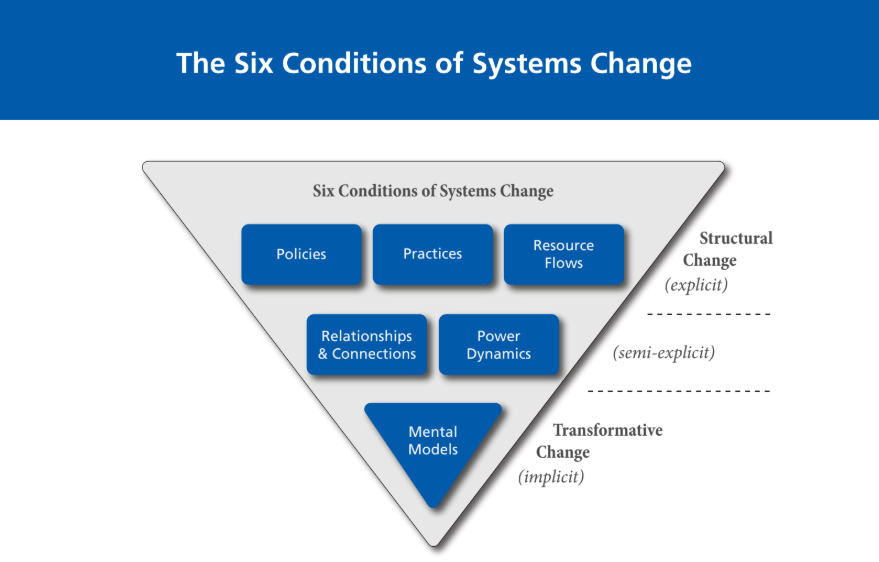
The Water of Systems Change article presents a systems-change framework for examining six conditions in complex systems to develop strategic, intentional actions that drive sustainable change. Rather than treating improvement as a series of disconnected initiatives, it encourages leaders to engage in root-cause analysis that strategically surfaces the system’s internal and external conditions that reinforce current outcomes and those that must shift to support lasting change.
At its core, it points to three areas leaders influence every day, often without naming them.
Structural conditions include the policies, roles, routines, and resource allocations that signal what the system prioritizes. These choices signal where time, attention, and energy are directed.
Relational conditions reflect how trust, collaboration, power, and accountability operate across the system for various stakeholders. These dynamics often determine whether strategies translate into action or stall in implementation.
Transformational conditions include the beliefs, assumptions, and shared meaning that shape how students, learning, and success are understood. Though less visible, these conditions influence every other part of the system.
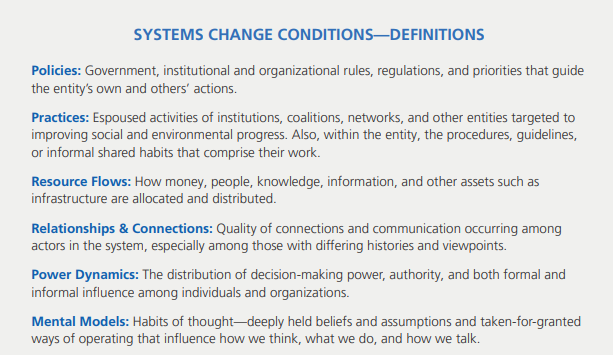
Sustainable improvement requires intentional alignment across all three. When conditions reinforce one another, improvement efforts gain coherence. When they are misaligned, even well-designed strategies fragment the work and lose impact.
The Role of Language in System Coherence
Language is a powerful system condition. The words organizations use signal priorities, shape behavior, and influence decision-making across the system. When language is unclear or inconsistent, it creates confusion about what matters most and how improvement is expected to happen.
In complex systems, language is rarely neutral or universally understood. Terms often carry different meanings depending on role, experiences, perspectives, and context. Without shared meaning, well-intended strategies can be interpreted differently across classrooms, schools, and departments, leading to misalignment and fragmented implementation. Furthermore, a lack of common language can lead to cultural conflict, confusion, and disconnection, resulting in incoherence and an inability to shift conditions within a system.
Intentional language alignment helps create coherence. When leaders co-develop common definitions, clarify how terms are used in practice, and revisit language as learning occurs, they strengthen shared understanding, buy-in, and trust. This work supports more consistent decision-making and reduces reliance on individual interpretation, shifting mental models, relationships, and power dynamics. These conditions often are the foundation for influencing structural shifts in policy, practice, and resources.
When language is inconsistent or initiative-driven, it creates confusion and dilution. Disciplined, shared language becomes a lever for improvement. It aligns strategy, implementation, and learning by clarifying goals, focusing attention, and supporting productive use of data. Rather than serving compliance or messaging alone, language becomes a practical tool that guides daily action. For example, the equity-driven initiative of 2020 triggered a shift in policies, practices, and resources in public education, resulting in intentional support for historically marginalized students. However, within this initiative, educators struggled to intentionally engage in developing common language with all educational partners to develop a shift in values and culture that would sustain the political shift and narratives about equity and DEI work. This has caused confusion and division amongst various educational partners, resulting in the elimination of equity-driven initiatives and funding. While equity work has proven impactful for all students, the term “equity” has become the focus of a new movement that undermines efforts to address student needs.
When language is aligned across planning documents, meetings, data conversations, and routines, systems are better able to sustain focus over time. Coherence grows not through slogans, but through consistent use of language that reflects how the work actually gets done.
In this way, language either accelerates improvement or quietly undermines it.
Leader Diagnostic: Examining System Conditions for Student Success
To move from add-ons to system redesign, leaders must pause long enough to examine how their system is currently producing results.
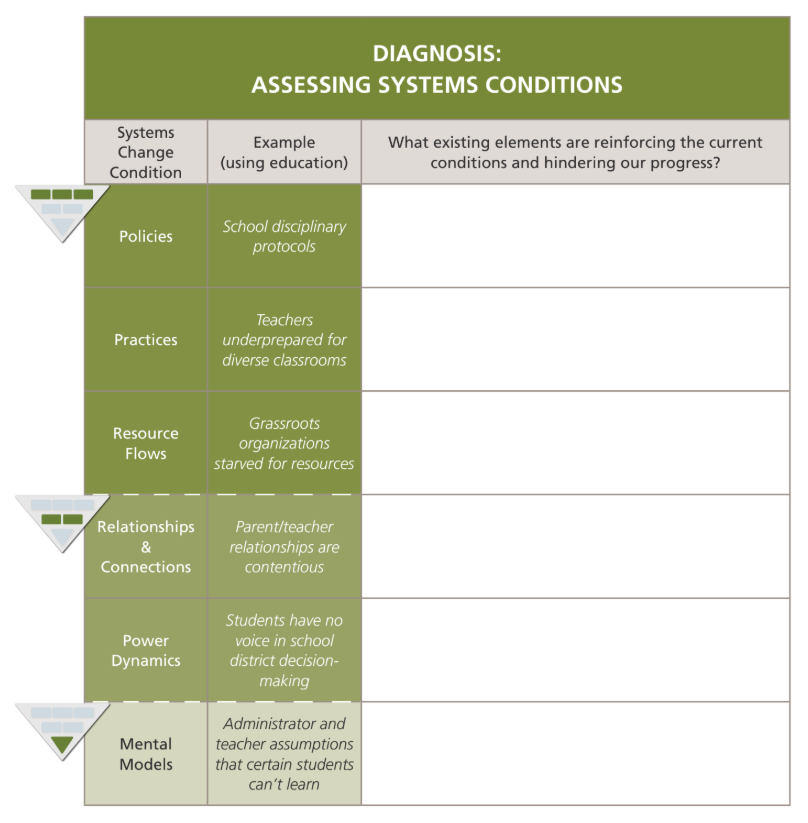
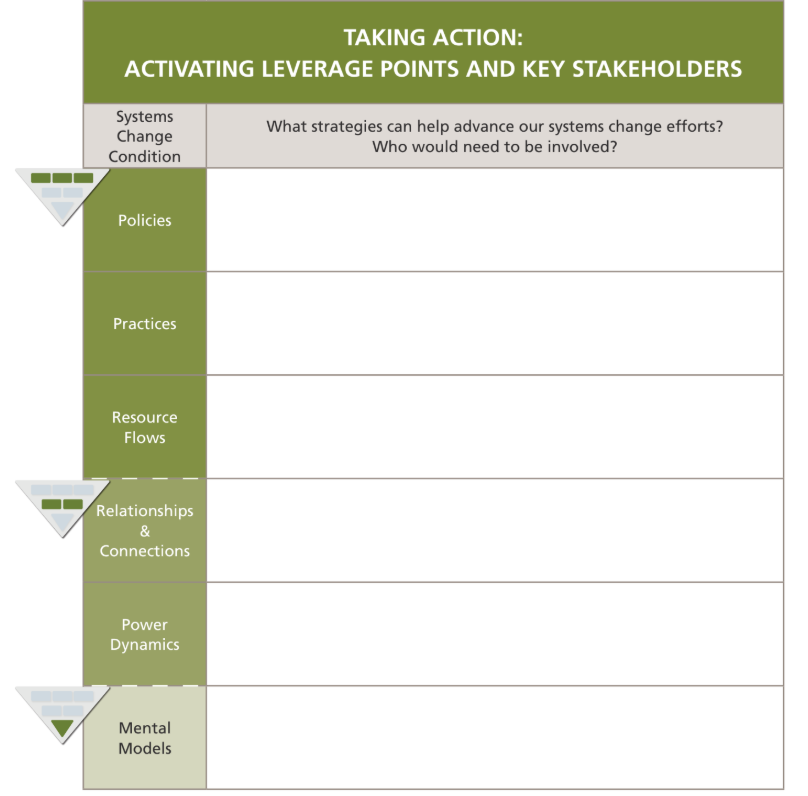
The questions below are designed to surface whether improvement is embedded in system design or dependent on isolated efforts; helping us to identify what matters most: not what we say we value, but what the system actually rewards and reinforces.
Clarifying the Focus
- How is student success currently defined in observable terms?
- Which outcomes are improving, and which remain predictable over time?
- Where do gaps persist despite multiple initiatives or interventions?
Examining Structural Conditions
- How do schedules, roles, and routines prioritize student success?
- Where do time, funding, and staffing decisions reinforce or dilute focus?
- Which decisions are made centrally, and which are left to individual interpretation?
Examining Relational Conditions
- How do collaboration and trust function across departments and schools?
- Where does influence sit when trade-offs are required?
- How is accountability experienced: as learning, compliance, or avoidance?
Examining Transformational Conditions
- What beliefs about students and learning show up in daily practice?
- How consistently is language used across strategy, data, and instruction?
- Where do assumptions go unexamined or unchallenged?
Using Data for Learning
- What quantitative data show patterns that require system-level attention?
- What qualitative data illuminate the lived experience of students and staff?
- What data are missing that would clarify root causes?
Designing for Action
- Which system conditions most directly sustain current outcomes?
- What shifts in policy, practice, or routines would have the greatest impact?
- How will the system learn, adjust, and monitor progress over time?
Reimagining student success begins with clarity. When a system clearly defines what student success means and aligns its structures, language, and routines to that definition, action follows naturally.
Without clarity, even good intentions lose direction. With it, priorities are aligned, decisions become sharper, and improvement becomes part of daily practice rather than an added task.
The challenge ahead is not to add more initiatives, but to clarify what matters most and intentionally design the system to serve that purpose.
Call to Action: Design the System for Student Success
The next phase of improvement work is not about adding more initiatives. It is about strengthening the conditions that drive results.
Start with a few high-leverage moves:
- Define student success in observable terms: Clarify what success looks like in practice and ensure that definition guides decisions, not just planning documents.
- Audit where influence actually sits: Examine how time, resources, and decision-making authority are allocated, and whether they reinforce or dilute focus on student success.
- Align language to daily work: Ensure that the language used in strategy, meetings, data conversations, and routines reflects shared meaning and consistent priorities.
- Build learning into system routines: Design regular opportunities for reflection, adjustment, and monitoring so improvement is continuous rather than episodic.
When student success is embedded in structures, decision-making, and shared language, equitable outcomes become predictable rather than aspirational. That is how systems change and how results shift.
Resources
Water of Systems Change article
Water of Systems Change action plan
Partner Newsletter – Project Clear
Partner News – Strengthening the Educator Pipeline Through Service Scholarships: California’s Golden State Teacher Grant Program Report

Partner Newsletter – Redesign Dispatch
Partner Newsletter – Project Clear
Accelerating Academic Achievement through CCEE’s Intensive Assistance Model
The California Collaborative for Educational Excellence (CCEE) celebrates significant growth in academic achievement among schools participating in the Intensive Assistance Model (IAM). After three years in the IAM, the 2025 CAASPP scores are showing impressive results for the first cohort of IAM LEAs.
Launched in 2022–23, the Intensive Assistance Model was established to address the growing need for districts requiring more comprehensive support through Direct Technical Assistance. Informed by research on districts that outperformed expectations, this initiative was designed to deliver focused and sustained support to LEAs aiming to strengthen instructional practices and improve academic outcomes for their students.
In this cohort, the Intensive Assistance Model utilized the PLC at Work framework. Through this collaboration, the Intensive Assistance Model leverages needs assessments, Professional Learning Communities (PLCs), and leadership coaching, and promotes common formative assessments, aligned curriculum, and data-informed instructional strategies, to incite positive growth among LEAs.
- This year, Highland Elementary (Inglewood USD) has seen extraordinary gains — +13.11% in ELA and +9.96% in Math on the 2025 CAASPP.
- Similarly, H.W. Harkness Elementary (Sac City USD) has seen remarkable growth of +6.42% in ELA and +5.06% in Math on the 2025 CAASPP.
- Fillmore Unified School District saw an increase of +6.38% in ELA and +2.13% in Math on the 2025 CAASPP.
To hear more about their journeys, tune into CCEE’s Podcast: Rising from the Margins. Dive into Episodes 2 and 3 of Rising from the Margins to hear about Highland’s journey through the power of focused coaching and collaboration.
In Episode 4, you can hear how focused, collaborative improvement helped Harkness set a new standard for student success.
Finally, listen to how educators and leaders at Fillmore USD are charting a new path for student achievement in Episodes 5 and 6.
In the Intensive Assistance Model’s short span of existence, it is already proving to make a substantial impact on LEAs. At CCEE, we are excited to continue to support and expand this model in order to grow our reach and impact on California’s schools and improve outcomes for all students.