CCEE Connection (January 2023)

News & Announcements
January Resources
  • Microlearning Modules – Designed to support substitute teachers, paraeducators, and other instructional staff, these short 5-8 minute videos share immediately applicable tips, strategies, and tools. Microlearning modules are also supplemented with downloadable handouts, instructions, and other materials and resources.
  • UDL Journey Guide – This digital travel companion guides district leaders and teams through four stages of implementing Universal Design for Learning (UDL), with connections to state and national supports along the way.
  • Dashboard Communications Toolkit – This toolkit provides materials to support LEAs with sharing the 2022 California School Dashboard data to parents, community members, and educators, along with additional resources for analyzing Dashboard data.

About the I3 Center

The Innovation, Instruction, and Impact (I3) Center implements a statewide approach to improving LEA capacity by collaboratively developing, delivering, sharing, and spotlighting practices that have demonstrated the power to improve outcomes for students.

About the CCEE

The California Collaborative for Educational Excellence is a statewide leader delivering on California’s promise of a quality, equitable education for every student.

Executive Director’s Corner

By Matt J. Navo, Executive Director, CCEE

Headshot of Matt Navo

CCEE uses data to improve and deliver its statutory and improvement obligations across the state. The Innovation, Instruction, and Impact (I3) Center is the backbone of data for CCEE. They support the agency in analyzing the organization’s effectiveness and in identifying “bright spots” in the state that other local educational agencies (LEAs) can learn from.

Under the leadership of Deputy Executive Director Sujie Shin, the goal of the I3 Center is to support the work of the CCEE, collaborate with state lead agencies, and use data to improve. This month’s newsletter highlights ways you can work with the I3 Center and other LEAs on various improvement initiatives related to improving outcomes for students through the use of data in your organization.


Measuring the Effectiveness of California’s Professional Learning Initiatives

By Allan Taing, Senior Manager of Research & Impact Analysis, CCEE

During the 2021-2022 budget cycle, the state invested $75 million across three grant programs to enhance the educator professional learning infrastructure within the Statewide System of Support. Through the Education Omnibus Trailer Bill of the 2021 State Budget Act, CCEE is working with our partners at the California Department of Education (CDE) and the State Board of Education (SBE) to support the county offices of education that have been selected as program leads for these grants to develop professional learning opportunities for learning acceleration, literacy, and open educational resources. The four-year $50 million Learning Acceleration System Grant Program will be led by Lake, San Diego, and Santa Clara County Offices of Education; the four-year $10 million Reading Instruction and Intervention Grant Program will be led by Contra Costa Office of Education; and the two-year $15 million High-Quality Online Instructional Materials Initiative will be led by Kern County Superintendent of Schools. 

In addition, evaluation leads have also been selected to lead rigorous program evaluations to determine the effectiveness of these professional learning initiatives. Education Northwest and Social Policy Research Associates will lead the evaluation of the Learning Acceleration System Grant, while the American Institutes for Research (AIR) will evaluate the Reading Instruction and Intervention Grant Program, and WestEd will evaluate the High-Quality Online Instructional Materials Initiative. 

An important component of these program evaluations is the connection of these professional learning initiatives to supporting system transformation, improving tiered supports, and measuring impact. To support larger statewide coherence, CCEE, CDE, and SBE are coordinating the work of these evaluation teams to develop a common set of data metrics across evaluations and to support alignment not only across these evaluations and other related programs, but also within the System of Support. These evaluation teams are convening on a recurring basis with the CCEE, CDE, SBE, representatives of the Statewide System of Support, designated county offices of education, and other selected partners in support of this coherence effort.

The first gathering was a “data boot camp” in July to support the evaluation teams with the data and resources available to them as they launched their evaluation projects. The second gathering in August brought in program evaluation teams conducting ongoing statewide system evaluations to share their lessons learned to the new evaluation teams. Moving forward, these convenings will occur on a bi-annual basis and the objective of these convenings will be to discuss data collection, analyses, interim results, and implications for ongoing development. The goal of this work on coherence and alignment is to uncover the evidence-based practices that promote educator professional development and ultimately support transforming education for all students in California. 


Balancing Data and Assessment Systems to Accelerate Learning

By Ingrid Roberson, Assistant Director of Research Learning, CCEE

Headshot of Ingrid Roberson

The Center for Innovation, Instruction, and Impact (I3) is excited to announce the I3 Data Research Learning Network (DRLN). The I3 DRLN brings together select districts and counties to innovate around data and assessments, focusing on one of two areas: Balanced Assessment Systems or Balanced Data Systems. To promote deeper learning, districts conduct a Balanced Assessment System review, ensuring that supportive policies, programs and practices are in place for formative assessment practices that promote student agency in the classroom. For more Balanced Data Systems, districts assess their current data systems through an equity lens, identifying opportunities for innovation. Districts can also capitalize on the latest data visualization technology for continuous improvement and community engagement.   

The I3 DRLN is a timely opportunity, especially for small to mid-size districts and counties, to leverage their data and assessment systems (and investments) to accelerate learning. According to Hilary Kjaer, Director of Teaching and Learning at one of the selected districts, “Rincon Valley Union School District is excited to embark on this journey with the I3 DRLN team! As we strive to develop a strategic plan for accelerating student learning, we know this is the perfect collaborative partnership.” The DRLN is a three-phase initiative with the Planning Phase starting in January 2023 and running through June 2023. To learn more about this innovative initiative, please see the I3 DRLN website which will be updated throughout the year.


Why Universal Design for Learning?

By James McKenna, Assistant Director of Professional Learning and Leadership Development, CCEE

Headshot of James McKenna

Universal Design for Learning (UDL) is the bedrock of best first instruction; it’s in every state curriculum framework and is the only framework required by the Every Student Succeeds Act. However, that’s not necessarily a compelling argument to engage educators to begin their implementation of UDL. They’re working hard as it is, and no one has time for “one more thing”. 

Except UDL isn’t one more thing. It’s a way to better achieve the things educators are already working hard to do — support language acquisition, engage students socially and emotionally, implement multi-tiered systems of support, and more. 

That’s why CCEE has partnered to develop the “Why UDL?” series of videos — to connect UDL to the work that people are already doing and to show how UDL can help them in those efforts. Working with our friends at TextHelp, we’ve recruited state and national experts to engage in conversations and presentations to better communicate how UDL connects to a variety of key initiatives. Housed on the Why UDL page of the UDL Journey Guide, these videos serve as learning opportunities for leaders and teams seeking to implement UDL who can then leverage them as part of their communications and stakeholder engagement efforts. 

CCEE is tremendously grateful for the collaboration provided by TextHelp and our speakers, all of whom volunteered their time and contributions to be able to offer these resources to educators across the state at no cost. 

UDL and…Speaker(s)
Blended LearningDr. Catlin Tucker, author, educator, and expert in blended learning
CA MTSSRhonda Marriot-Spencer, CA SUMS and Orange County Department of Education
Equity and AntiracismAndratesha Fritzgerald, author, educator, and expert in UDL, equity, and antiracism;
David Toston, Senior Advisor of Equity and Innovation, CCEE
Expert LearningDr. James McKenna, Assistant Director, CCEE and expert in Universal Design for Learning 
Language LearnersDr. Soomin Chao, Multilingual Academic Support;
Elise Yerkey, Inclusive Design, from the Los Angeles County Office of Education
Social Emotional Learning (SEL)Lisa Bosio, expert and consultant at Novak Education
Special EducationHeather Calomese, Director of Special Education, CA Dept of Education;
Kevin Schaefer, Director of Equity and Inclusive Practices, Supporting Inclusive Practices;
Mindy Fattig, Senior Advisor of System of Support, CCEE

Amplifying Innovative Practices Through District Spotlights

By Dorcas Kong, Senior Specialist of Executive Projects, CCEE

Headshot of Dorcas Kong

The Innovation, Instruction, and Impact (I3) Center is excited to soon be launching what we’re calling the Spotlights Project. Aligned with the goal of the I3 Center, the Spotlights aim to curate stories that identify and amplify emerging practices from school and district teams to collaboratively provide students in California with what they need to thrive. 

In the coming weeks, the I3 Center will be publishing Spotlights on different local educational agencies (LEAs) that have implemented innovative and inclusive practices to improve 1) student academic outcomes; 2) student/family engagement and well-being; 3) staff and community supports; or 4) systems, policies, and governance. The Spotlights will shine a light on not only the successes, but also the challenges, pitfalls, and lessons learned to serve as blueprints for other LEAs facing similar issues. Although LEAs across California vary in size and demographics, we hope these documented success stories can pave a way for LEAs to become learning organizations — absorbing the lessons learned, leveraging those perspectives to create accessible points of conversation, and generating ideas around other innovative pathways to replicate some of these successes across the state.

CCEE Connection (October 2022)

News & Announcements
October Resources
  • Lifting Our Voices Field Guides – Developed in partnership with the California Association of African American Superintendents and Administrators (CAAASA), the Lifting Our Voices Field Guides document the different perspectives, experiences, and reflections of our students, teachers, parents, and families of color, allowing us to harness the power of the “lessons learned” in 2020 and 2021 to reimagine a more successful educational experience for all students in California.
  • Microlearning Modules – Short 5-8-minute videos that share immediately applicable tips, strategies, and tools. Designed to support substitute teachers, paraeducators, and other instructional staff, these short 5-8 minute videos share immediately applicable tips, strategies, and tools. Microlearning modules are also supplemented with downloadable handouts, instructions, and other materials and resources.
  • UDL Journey Guide – This digital travel companion guides district leaders and teams through four stages of implementing Universal Design for Learning (UDL), with connections to state and national supports along the way.

Meet the I3 Team
Headshot of Ingrid Robinson

Ingrid Robinson
Assistant Director of
Research Learning

Please join us in welcoming Ingrid Robinson, our newest member of the I3 Center! As the Assistant Director of Research Learning, Dr. Robinson will be leading CCEE’s Research Learning Network to provide data analysis support, coaching, and technical assistance for local educational agencies (LEAs). Prior to joining CCEE, she served as the Associate Superintendent of the Academic Services Division at the Alameda County Office of Education.

Fun Fact: Ingrid has been a certified scuba diver for nearly a decade, traveling the world with her teenage son and diving with dolphins, manta rays, and even sharks – at night.


About the I3 Center

The Innovation, Instruction, and Impact (I3) Center implements a statewide approach to improving LEA capacity by collaboratively developing, delivering, sharing, and spotlighting practices that have demonstrated the power to improve outcomes for students.

About the CCEE

The California Collaborative for Educational Excellence is a statewide leader delivering on California’s promise of a quality, equitable education for every student.

Executive Director’s Corner

By Matt J. Navo, Executive Director, CCEE

Headshot of Matt Navo

At the core of continuous improvement is the use of data – data that allows educators to evaluate, reframe thinking, and adjust accountability for improvement. 

After a two-year hiatus due to the COVID-19 pandemic, local educational agencies will again focus on continuous improvement within the state’s accountability framework. At the recent State Board of Education meeting on September 14, 2022, the State Board reaffirmed its commitment to continuous improvement by approving modified accountability determination criteria on the upcoming 2022 Dashboard to support local educational agencies (LEAs). 

CCEE works in partnership with the State Board of Education and the California Department of Education to use data to inform how to best support LEAs across the state in improving student outcomes. That means that our state is working to model continuous improvement to provide the tools to examine and measure student outcomes in a way that is helpful to local educators and communities. 

The Innovation, Instruction, and Impact (I3) Center is responsible on behalf of the CCEE to collect and provide data on projects that support the ability of the CCEE and other state lead agencies to support LEAs with their continuous improvement processes. This month’s newsletter will highlight some projects and initiatives led by the I3 Center.


Successes and Challenges in Reducing Chronic Absenteeism

By Sujie Shin, Deputy Executive Director, CCEE

Headshot of Sujie Shin

Chronic absenteeism has affected a significant percentage of California’s K-12 student population and is likely to continue to do so over the coming years due to the lasting impacts of the COVID-19 pandemic. 

From January to July of 2022, CCEE convened the Chronic Absenteeism Research Learning Network (RLN) under the leadership of Aldo Ramirez, Assistant Superintendent of Educational Services for the Salinas City Elementary School District, to understand district successes and challenges in reducing chronic absenteeism and its implications for statewide support. This working group of educational partners identified 80 school districts that had made significant progress in addressing chronic absenteeism in California over the past five years and interviewed teams from nine districts across the state, varying in size and grade spans.

The Chronic Absenteeism RLN published a brief that aims to better understand how the issue of chronic absenteeism has been addressed by districts and what improvements could yield better student outcomes. It highlights insights and best practices collected from districts that were able to decrease their chronic absenteeism rate in the past five years and offers recommendations on how local educational agencies (LEAs) could help increase student attendance.

Click on the headers below to learn more about this work. The full brief, which delves deeper into the data, best practices and strategies, and opportunities for statewide support, can be found on this webpage.

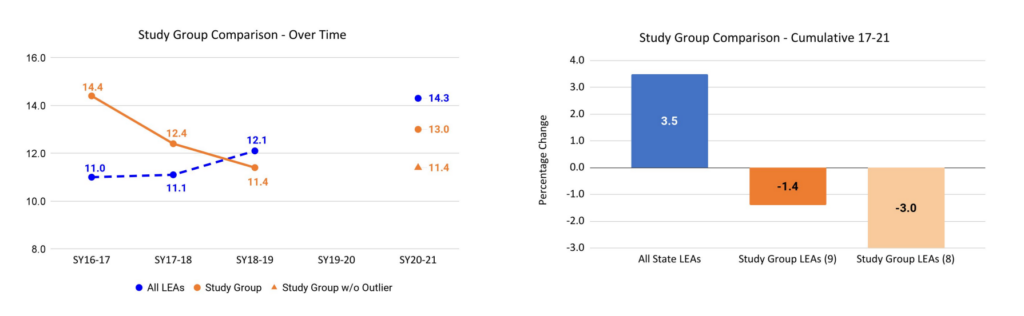
Cumulatively, the group of nine LEAs studied demonstrated a decrease of 1.4% in chronic absenteeism rates from 2017-2021, while all LEAs in California experienced an increase of 3.5% (for a total difference of 4.9 percentage points). More impressively, when we removed an outlier district from the group of nine that saw its absenteeism rates go past the 25% mark during the pandemic, the remaining eight LEAs in the study shared a collective gain of 3.0% over the 2017-21 time period — a difference of 6.5 percentage points from all California LEAs during the same time. Finally, the LEAs in this study still remained below the state average of 14.3% for SY20-21 — with or without the outlier district (see picture below).

Although the nine districts had slightly different approaches to improving attendance (based on community and context), they shared common characteristics and offered some replicable takeaways. These takeaways aligned with the CCEE’s theory of action framework of leveraging both mindsets and processes to create continuous improvement cycles that lead to change and improve student outcomes. Successful districts shared the following mindsets and practices:

  1. Shifting mindset and building understanding
  2. Leveraging strong data practices
  3. Integrating practices across the whole district
  4. Utilizing early intervention
  5. Providing consistent and focused wraparound communications
  6. Ensuring strong support and staffing
  7. Maximizing community partnerships 
  8. Developing flexible paths for students

Based on the information gleaned from district leadership teams in the course of six months, the workgroup highlighted six potential areas for implementing systemic practices that could help mitigate chronic absenteeism:

  1. Clear and consistent messaging and communication 
  2. Flexibilities around how and when learning takes place 
  3. Updates to the School Attendance Review Team (SART) and the School Attendance Review Board (SARB)
  4. Training and tools to support attendance
  5. Forging a path for a more “connected system” and inter-agency collaboration
  6. Effective data systems and practices

Leveraging Lessons Learned to Advance Educational Equity

By Dorcas Kong, Senior Specialist of Executive Projects, CCEE

The National Coalition on Education Equity (NCOEE), along with its partners, Indiana Council on Educating Students of Color, WestEd, National Council on Educating Black Children (NCEBC), and the California Association of African American Superintendents and Administrators (CAAASA) hosted a national conference from October 5-7, 2022 in Indianapolis, Indiana. The 2022 National Equity in Action Conference brought together educational stakeholders from across our nation to learn about and share transformational programs and practices to improve outcomes for students of colors, marginalized students, and students with disabilities. 

Sujie Shin, Deputy Executive Director, joined Dwight Bonds and Ken Wesson from CAAASA to present the Lifting Our Voices Field Guides, which leverage the experiences and reflections of students, teachers, and families of color during the COVID-19 pandemic to serve as guides for reimagining a more equitable educational experience for our students. Although this project came out of the pandemic to document “lessons learned” in 2020 and 2021, the Field Guides shed light on the greater equity challenges that continue to be faced by our students of color. CCEE collaborated with CAAASA to package those lessons learned into meaningful professional learning opportunities that can be assessed as a PDF or through an interactive, web-based learning path. Each Field Guide includes focused learning objectives; video clips of leading educational professionals; interviews with students, teachers, and parents; reflective questions and differentiated professional learning activities that can be used with a variety of audiences; and links to additional resources and tools.

CCEE had the opportunity to engage in a conversation with our partners at CAAASA about the Lifting Our Voices Field Guides. Click on the questions below to view their responses.

The Lifting Our Voices Field Guides lend themselves towards professional learning that provides essential information to any educator who regularly works with African American students at any grade level. It is not uncommon for educators to believe that treating all students in an identical manner meets the ethical goal of equality in education (“fairness”). However, all patients in a hospital emergency room should not be administered the same medical remedy for their Illness, since there is an almost unlimited range of medical needs. Effectiveness is a considerably more significant goal in education than sameness, acknowledging that each student comes to school with a wide array of academic needs. In any American classroom, students enter that room with unique academic histories, a wide continuum of background knowledge, various levels of competency in different subject areas, along with multiple ways of demonstrating their conceptual understanding. Most importantly, many African Americans share a long history, as well as numerous contemporary lived experiences that impact both how they view formal education and how they respond to daily educational procedures. Being cognizant of this background information is critical for anyone charged with teaching African American students from Pre-K through graduate school.

The entire collection of Field Guides offers a wealth of information, charts, graphs, statistics, questions and answers, first-person testimonies, resources, references, and videos that can also be used to support both online and in-person professional development for individuals or teams, as well as teacher training courses offered by any college of education. Focused on 12 different subject areas that impact education for today’s African American students, the Field Guides are available in a downloadable PDF format or as an online, interactive learning path, with built-in QR codes and icons with video instructions.

The most important equity challenge facing educators can be found in the question, “What do I need to know about the daily experiences of African American students for my own teaching effectiveness?” It is difficult to successfully teach students knowing little or nothing about their culture, backgrounds, needs, lived experiences, etc. — all vital information for successful educators.

Middle-class teachers are frequently unaware of the daily difficulties that students of color and poverty experience, which affect how those children both behave in school and learn in class. When students cannot relate to the values presented by the teacher, the content, and/or illustrations in the curriculum, student engagement will be minimal at best. The values of the dominant culture are often so foreign to students of poverty and of color that those values are rejected because there is no correlation with the lived experiences of black and brown students.

Educators are cognizant that student engagement comes by way of the relevance that students see in the curriculum or by the linkages that a teacher makes between students and the adopted curriculum. Among the most significant lessons that we have learned about formal education is that a clear distinction must be made between “equality” (treating the same) and “equity” (giving each student what he or she personally needs). The Lifting Our Voices Field Guides unashamedly focus on the equity needs of African American students and students from other communities of color. Meeting their specific needs is how education can truly be advanced.


Upcoming Resources for UDL Implementation

By James McKenna, Assistant Director of Professional Learning and Leadership Development, CCEE

Headshot of James McKenna

The California Collaborative for Educational Excellence (CCEE) is committed to advancing the implementation of Universal Design for Learning (UDL) in California and is actively partnering with county offices, System of Support leads, and national organizations in that effort. We’d like to take this opportunity to highlight some of the new resources we will be releasing later this fall.  

The UDL Journey Guide is getting an upgrade! First released in February of this year, the Journey Guide supports district leaders and teams to plan their implementation of UDL and connects them with state and national partners that can support them in those efforts. CCEE is currently partnering with CAST, the Center for Applied Special Technology and the inventors of UDL, to refine the Journey Guide to provide implementation guidance in alignment with CAST’s UDL School Implementation Certification Criteria.  

CCEE has also partnered with TextHelp to produce the “Why UDL” video series, connecting UDL to key efforts such as advancing equity and antiracism, supporting students with disabilities and language learners, aligning to California’s Multi-tiered System of Supports (CA MTSS), and more. These videos can support your learning as well as become part of your communication and engagement efforts within your community. The full series will be released in November, but below is the first video – “What is UDL?”.  

Finally, we are hard at work on our first UDL learning path made specifically for teachers. Working with partners in the field and guided by an advisory group of classroom teachers, we will offer this asynchronous, interactive online learning option openly and freely to all who are interested in learning more about classroom implementation of UDL. We hope to launch this learning path by mid-November.  

For more information on CCEE’s work in UDL and to share your thoughts, needs, questions, and more, contact us at [email protected]


NEW: Learning Path for High-Impact Tutoring

By Nhi Hang, Program Specialist, CCEE

Headshot of Nhi Hang

The Abdul Latif Jameel Poverty Action Lab (J-PAL) North America and the California Collaborative for Educational Excellence (CCEE) partnered to develop an interactive learning path on Implementing Evidence-Based Tutoring for High Impact. The learning path features seven modules to support district leaders looking to implement, improve, and reflect on the impact of their tutoring programs. 

With each module including videos and supporting resources, district and charter school leaders can deepen their understanding of the research behind tutoring before diving into the elements of highly impactful programs. Such elements include the importance of engaging stakeholders, finding effective tutors and training, as well as evidence-based components of program delivery. Furthermore, the interactive learning path describes how to conduct process and impact evaluations to assess the implementation as well as the results of a program.