Summer Game Plan Series

DESCRIPTION

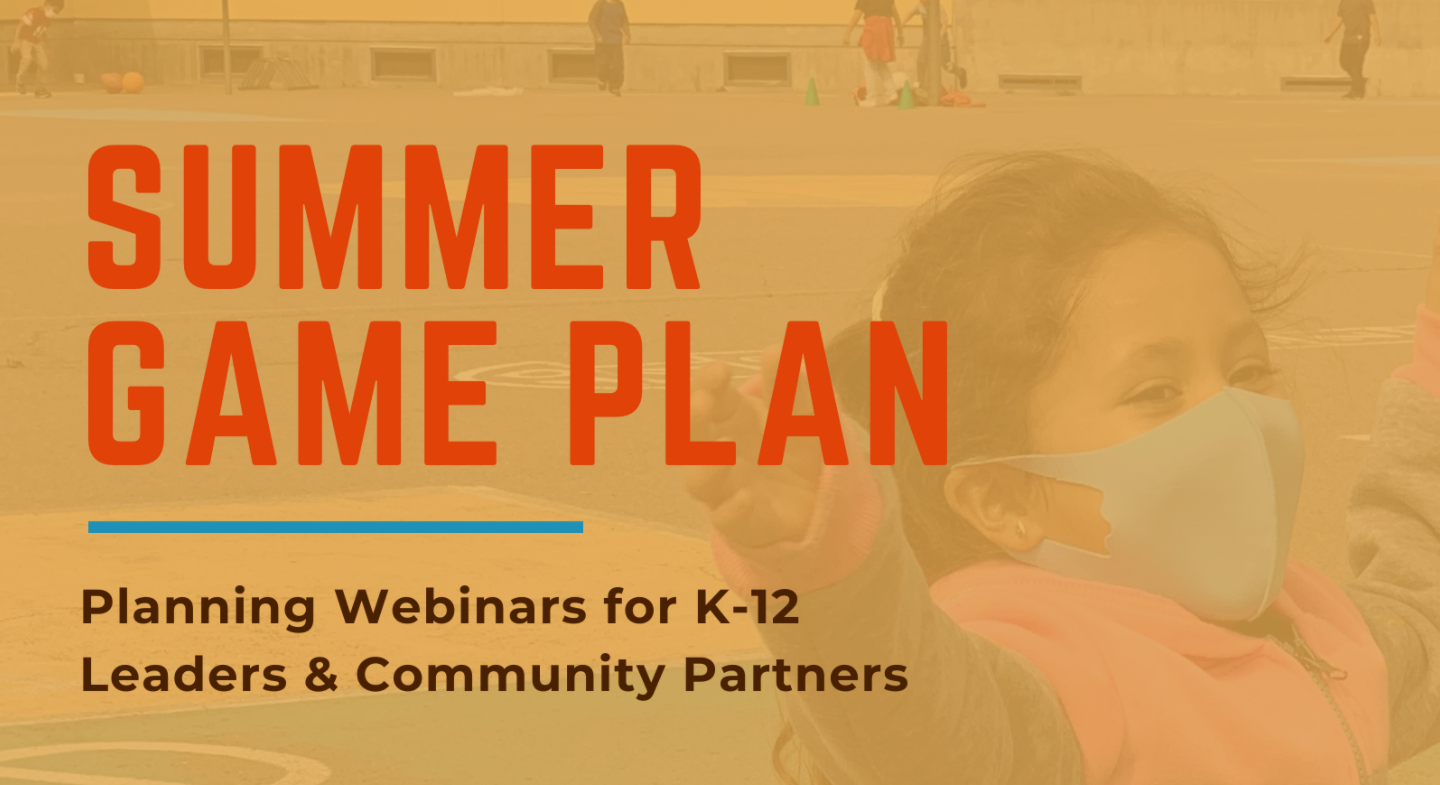
This summer is more important than ever to help students begin to recover from the learning loss, isolation, and trauma of the past year. Designed for K-12 administrators, educators, and community partners, the Summer Game Plan series provides strategies to navigate challenges in planning summer learning programs, resources to aid your planning, and the latest research and guidance from nationally recognized experts.

OFFERED IN COLLABORATION WITH

Partnership for Children & Youth

SUMMER RESEARCH, PRACTICE, & FUNDING: FOUNDATIONS FOR SUMMER PLANNING

This webinar covers the latest national research on strategies and practices that contribute to impactful summer programs, and updates on state and federal funding to help inform local planning.

CREATIVE SOLUTIONS FOR SUMMER STAFFING

This webinar explores a range of creative staffing models that ensure high-quality staffing while meeting other goals, such as developing future school leaders, providing more planning and collaboration time, and expanding experience operating blended staffing models.

CREATING ENGAGING SUMMER LEARNING OPPORTUNITIES FOR HIGH-SCHOOL YOUTH

This webinar provides examples of enrichment programs that provide opportunities for high school youth to engage in real-world experiences, connect with mentors, earn income and/or school credit, and build leadership and collaboration skills.

PARTNERING WITH HIGHER EDUCATION AND PRE-SERVICE TEACHERS

Summer learning provides a unique training ground and flexible learning space for teacher preparation and pre-service teachers. This webinar provides examples of how school districts can leverage higher education partners to recruit new teachers and teachers candidates from existing teacher pipeline programs.

MEETING THE NEEDS OF EARLY LEARNERS THIS SUMMER

Many families chose not to enroll their children in pre-kindergarten and kindergarten in the 2020-21 school year for a variety of reasons, including concerns that distance learning is not well-suited for younger students. This webinar explores how summer programs can meet the needs of younger learners and their families, especially those minimally engaged in school this past year.

SUMMER PROGRAM MARKETING, ENROLLMENT, AND ENGAGEMENT

Summer attendance and outreach is always difficult, especially among underserved students, and is likely to be even more challenging after a year of distance learning. This webinar explores best practices for creatively and strategically coordinating outreach to families and students about the benefits and opportunities of participation in summer learning programs.

RESOURCE TYPE

Media, Professional Learning

TYPE OF AUDIENCE

Site Administrator / Instructional Coach, Systems Leadership, Teacher

TOPIC AREA

Continuous Improvement, Equity, LCAP

KEYWORDS

Leading Forward, Summer Learning

THE TRANSFORMATIVE POTENTIAL OF TUTORING FOR PREK-12 LEARNING OUTCOMES

DESCRIPTION

Researchers at Northwestern University, University of Toronto, and J-PAL at MIT conducted a meta-analysis of 96 high-quality studies on tutoring programs. These resources summarize key takeaways and outline evidence-based principles that district leaders should consider in order to bring high-quality tutoring to their communities.

AUTHORS

Andre Joshua Nickow, Northwestern University

Philip Oreopoulos, University of Toronto

Vincent Quan, J-PAL North America, MIT

REFERENCES

RESOURCE TYPE

Professional Learning

TYPE OF AUDIENCE

Site Administrator / Instructional Coach, Systems Leadership, Teacher

TOPIC AREA

Equity, LCAP

KEYWORDS

Accelerated Learning, Tutoring

Summer Program Marketing, Enrollment, and Engagement

DESCRIPTION

Summer attendance and outreach is always difficult, especially among underserved students, and is likely to be even more challenging after a year of distance learning. Districts, schools, and their community partners need to creatively and strategically coordinate outreach to families and students about the benefits and opportunities of participation in summer learning programs.

This is the fifth webinar in Partnership for Children & Youth (PCY)’s Summer Game Plan webinar series.

PRESENTERS

Patty Chavez, Parent Institute for Quality Education
Brenda McLaughlin, Sperling Center for Research & Innovation
Ronnie Stone, Southeast Ventura County YMCA

VIDEO

SLIDES

LAUNCH SLIDES

RESOURCES

SUMMER LEARNING TECHNICAL ASSISTANCE HUB

SUMMER GAME PLAN WEBINAR SERIES

RESOURCE TYPE

Media, Professional Learning

TYPE OF AUDIENCE

Board, Site Administrator / Instructional Coach, Systems Leadership, Teacher

TOPIC AREA

Equity, LCAP

KEYWORDS

Leading Forward, Summer Learning, Summer Recruitment

Does It Quack Like a Duck? Would I Know a Balanced Assessment System If I Saw One?

DESCRIPTION

This session includes examples and partial examples from the field to help participants understand what developing systems look like in practice. Participants will hear from district assessment leaders across the country from various size school districts to understand how they are adapting the theory and practice of balanced assessment system development to their contexts. Participants will gain a good understanding of the challenges faced by these various leaders and hear how they are trying to overcome them.

PRESENTERS

Scott Marion, Ph.D., Executive Director, Center for Assessment

Peter Leonard, Director of Assessment, Chicago Public Schools

Kadie Wilson, Assistant Superintendent of Schools, SAU9

VIDEO

SLIDES

RESOURCES

PAST SESSIONS

RESOURCE TYPE

Media, Professional Learning

TYPE OF AUDIENCE

Site Administrator / Instructional Coach, Systems Leadership, Teacher

TOPIC AREA

Continuous Improvement, Equity, LCAP

KEYWORDS

Assessment, Leading Forward, Rural Schools/Districts

Assessment for Learning in Extraordinary Times

DESCRIPTION

How do you know if students are with you at the beginning, middle, and end of a lesson? Can formative assessment offer a key to better teaching and learning during instruction? In this three-part series, participants will learn how to blend different formative assessment moves in the classroom, with intention and care for all students, to help make better instructional decisions. These sessions will explore the following seven research-based, high-leverage formative assessment moves: priming, posing, pausing, probing, bouncing, tagging, and binning.

PRESENTERS

Dr. Brent Duckor, President, Validity Partners

Dr. Carrie Holmberg, Associate, Validity Partners

THE POWER OF POSING, PAUSING, AND PROBING TO ADVANCE DEEPER LEARNING

This session introduces the first three of seven formative assessment moves: posing, pausing, and probing. Participants will learn how and when to ask questions, encourage student responses, and deepen discussions in online, hybrid, and in-person settings.

THE POWER OF BOUNCING, TAGGING, AND BINNING FOR FEEDBACK TO ADVANCE DEEPER LEARNING

This session explores how bouncing, tagging, and binning can be employed in online, hybrid, and in-person settings. Participants will learn how to sample student responses to broaden participation, describe and record students responses without judgement, and interpret student responses with a wide range of tools.

FORMATIVE ASSESSMENT MOVES TO UNCOVER ACADEMIC LANGUAGE DEMANDS AND SUPPORT ENGLISH LEARNERS

To ensure equity in our formative assessment practices, we must think carefully about academic language demands for everyone including our EL students. In this session, we explore the power of the seven formative assessment moves framework to increase students’ academic language use and production in online, hybrid, and in-person settings.

RESOURCE TYPE

Professional Learning

TYPE OF AUDIENCE

Site Administrator / Instructional Coach, Systems Leadership, Teacher

TOPIC AREA

Continuous Improvement, Equity, LCAP

KEYWORDS

Formative Assessment

Developing & Implementing Balanced Assessment Systems

DESCRIPTION

The call for balanced assessment systems resulted from a recognition that most assessments poorly served a primary purpose of assessment—improving learning and instruction. Educators understand that large-scale summative tests are far too distal from instruction, at the wrong grain size, and administered at the wrong time of year to make a difference in their daily practice. Further, many district leaders turned to commercially available district assessments that do not clearly link to other levels of the system (Perie, Marion, & Gong, 2009). Therefore, the calls to balance assessment systems—actually rebalance these systems—were motivated by the desire to enhance the utility of assessments for improving learning and instruction as well as for monitoring, accountability, and evaluation. 

This series will help school and district leaders understand the value proposition for balanced assessment systems, key design features of such systems, the challenges to implementation, and benefits from practical suggestions for overcoming these challenges.

FACILITATED BY
Scott Marion, Ph.D., Executive Director, Center for Assessment

INTRODUCTION TO BALANCED SYSTEMS OF ASSESSMENT

This session presents the rationale for balanced assessment systems, articulates the intended uses of assessment results, and introduces the criteria for judging the balance of an assessment system. It concludes with a discussion about the barriers to implementing balanced assessment systems.

THE CRITICAL ROLE OF CURRICULUM & LEARNING PROGRESSIONS IN BALANCING ASSESSMENT SYSTEMS

This session focuses on the most important criterion for balancing assessment systems—coherence—and how it can be supported with high-quality curriculum and learning progressions. Curriculum and learning progressions provide a foundation for designing assessments and assessment systems. Even more importantly, they provide an interpretative lens to understand the instructional power of assessment results. This session highlights features that distinguish high-quality curriculum and learning progressions from lower quality processes and products.

THE COMPONENTS OF A BALANCED ASSESSMENT SYSTEM

There is an unfortunate “urban legend” about balanced assessment systems. Many often think that a balanced assessment system includes summative, interim, and formative components. This session looks at key features of various types of assessments to help participants learn how to evaluate components of an assessment system in light of its intended purpose and use. The session will discuss what it takes for assessments to be instructionally useful and will explore the power of curriculum-embedded, unit-based assessments.

THEORIES OF ACTION AS A TOOL FOR DEVELOPING & IMPLEMENTING BALANCED ASSESSMENT SYSTEMS

This session introduces theories of action as a tool for helping district and school leaders identify the problems/issues they are trying to address through the design and implementation of assessment systems. Theories of action provide a comprehensive framework for analysis, evaluation, and continuous improvement. In addition to understanding the usefulness of theories of action, participants will explore several practical tools to help them begin developing theories of action for balanced systems of assessment.

DOES IT QUACK LIKE A DUCK? WOULD I KNOW A BALANCED ASSESSMENT SYSTEM IF I SAW ONE?

This session looks at real examples from the field to help participants understand what developing systems look like in practice. District assessment leaders from various size school districts will share how they’re adapting the theory and practice of developing balanced assessment systems to their contexts. Participants will gain an understanding of the challenges faced by these leaders and hear how they are trying to overcome them.

Brain-Considerate Learning with Dr. Ken Wesson

DESCRIPTION

Speaker and educational consultant in neuroscience Dr. Ken Wesson joins Leading Forward to share insights about the science of learning. In 25 minutes, Dr. Wesson explains the relationship between emotion, attention, and memory, and how educators can leverage current scientific understanding to help engage students.

SPEAKER

Dr. Ken Wesson, Educational Consultant, Neuroscience

LEADING FORWARD PODCAST

Leading Forward to Advance Racial Equity in Summer ‘21 and Beyond

DESCRIPTION

Interested in how your summer programming can advance racial equity? Join Desiree Carver-Thomas and Larkin Willis of the Learning Policy Institute (LPI) for a fast-paced primer for the recently-released “Districts Advancing Racial Equity” (DARE) Tool. The video presentation provides practical support and tips for applying the tool to planning, implementing, and improving current and future summer programs.

PRESENTERS

Desiree Carver-Thomas, Learning Policy Institute

Larkin Willis, Learning Policy Institute

DISTRICTS ADVANCING RACIAL EQUITY

ADDITIONAL TOOLS & RESOURCES

Build on the DARE foundation with these curated resources and tools designed specifically to support summer programming:

Receive FREE individualized support and explore FREE resources, toolkits, and templates to launch a successful summer learning program!

As part of the #LeadingForward2021 initiative, CCEE convened an expert panel to discuss examples of district innovation, staffing solutions, key elements to consider when planning summer programming, and opportunities for district/community-based organization collaboration. Click here for Summer Programming 2021: Game Planning Now for Summer Learning, Fun, and Equity.

PARTNERSHIP FOR CHILDREN AND YOUTH SUMMER GAME PLAN VIDEOS

Meeting the Needs of Early Learners This Summer

Summer Staffing: Partnering with Higher Education and Teacher Candidates

Creating Engaging Summer Learning Opportunities for High-School Youth

Creative Solutions for Summer Staffing

Summer Research, Practice and Funding: Foundations for Summer Planning

The “Mind Platter” for Student Well-being with Dr. Daniel Siegel

DESCRIPTION

New York Times bestselling author, neuropsychiatrist, Mindsight educator, and interpersonal neurobiologist Dr. Dan Siegel joins the Leading Forward Podcast to talk about learning, mental health, and fostering student well-being through a focus on seven components for healthy living, which he calls the “healthy mind platter”.

SPEAKER

Dr. Dan Siegel, Executive Director of the Mindsight Institute, Clinical Professor of Psychiatry at the UCLA School of Medicine, Co-director of the Mindful Awareness Research Center at UCLA

LEADING FORWARD PODCAST

CAAASA Field Guide 2: Learning and Healing Together

DESCRIPTION

CAAASA Field Guide 2: Learning and Healing Together explores the relationship between emotions and learning, including the considerable stressors experienced by students, families, and educators during the COVID-19 pandemic. Hear from authentic voices in the field, including administrators, teachers, parents, and students, and engage in targeted professional learning.

DEVELOPED IN PARTNERSHIP WITH

California Association of African-American Superintendents and Administrators (CAAASA)

Launch E-Learning