Resource Category: Governance (Research & Policy)
CCEE Connection (February 2022)

DESCRIPTION
This month’s newsletter is brought to you by our Teaching, Learning, and Leading Center and some of the LEAs they work with. It highlights one of the unique pathways that Monterey County Office of Education is taking to inspire students to dream big. Solano County Office of Education and Vallejo City Unified School District take readers on their journey in Improvement Science. The newsletter also contains resources honoring Black History Month.
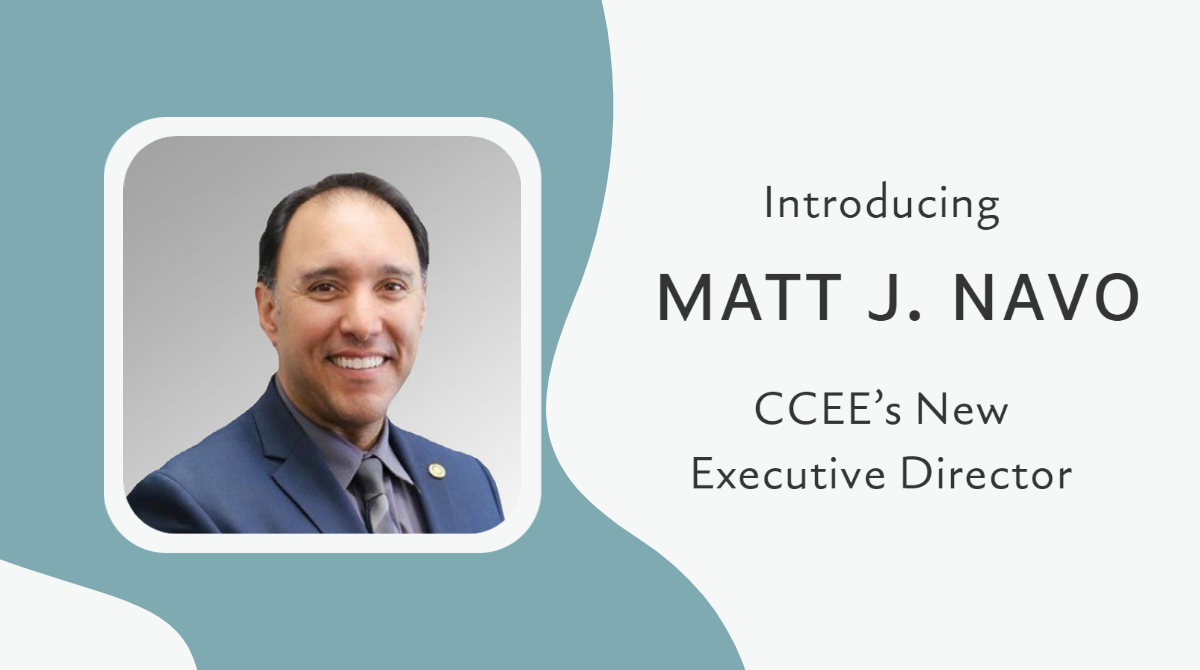
Introducing Matt J. Navo, CCEE’s New Executive Director
DESCRIPTION
Dorcas Kong, Senior Specialist, interviewed CCEE’s new Executive Director, Matt J. Navo, about how he plans to lead CCEE in its efforts to accelerate learning and advance equitable outcomes for all students.
Please note that the interview was edited for clarity and length.
INTERVIEW PANEL
Matt J. Navo, Executive Director, CCEE
Dorcas Kong, Senior Specialist, Executive Projects, CCEE
Could you tell us about your background and experiences that prepared you for your new role?
I had the opportunity to work in various educational settings. I started as a fifth-grade teacher when I was 21 and a half years old. I had no student teaching experience, but it was at a time when you could do that sort of thing. A principal, a good friend of mine, said, “I’ve got a great opportunity for you. The class only has five students.” And at that point, I didn’t know much about education, other than I wanted to be an elementary school teacher so I said, “Oh my god, that sounds amazing.” I was placed in that class the following year and it ended up being an SDC, a special day class, 4th-6th grade combo, in my second year of teaching. And I was shocked and had the anxiety that came with not knowing anything about special education. I went back to school and got my master’s degree in special education. Every job subsequently after was connected to serving students with special needs. And that’s where every opportunity that I’ve had as an educator has come from — serving students with special needs.
I had an opportunity to go to Sanger Unified School District in 1999. At that time, there were a lot of stories about Sanger Unified and how it was not a place that people were aspiring to go and learn, build a career, or raise a family. But that’s where I got a lot of my experiences. It was incredibly difficult, but it was also incredibly rewarding to be a part of a system that transformed itself over time. I was an administrator for a junior high school and a counselor at the high school level. In 2013, I became the superintendent of Sanger Unified. And then slowly but surely, a myriad of experiences opened for me because I was serving students with disabilities.
The first opportunity I had to serve at the pleasure of the governor, was as Governor Brown’s appointee on the Advisory Commission on Special Education (ACSE). They were looking for a superintendent that had special education experience. And shortly after that, the Special Education Task Force was curating a committee and wanted a district superintendent with special education experience. So I had the opportunity to serve Maureen Burness, Vicki Barber, and Carl Cohn, as the chair of the Evidence-Based Practices Subcommittee for the Special Education Task Force report.
After that, opportunities kept opening to serve at the pleasure of the governor with a special education emphasis. I was able to serve on CPAG, which was the California Practitioners Advisory Group and then Governor Brown appointed me to serve on the CCEE Governing Board in 2015. I served as the superintendent representative until I left the superintendency and ultimately, that opened the door to serve on the State Board of Education because you can’t serve on the State Board if you’re a superintendent as it’s considered a conflict of interest.
All of a sudden, I wasn’t a superintendent and yet had all of the experiences that they were looking for on the State Board. My name crossed Governor Newsom’s desk and he tapped me to sit represent him on the State Board of Education. That all happened because I was not a superintendent and then lo and behold, because I’m on the state board, Board Chair Linda Darling-Hammond board chair, in the garden, Hammond asked me to chair the CCEE Governing Board, which I had served previously. So it has all kind of come full circle. All these circumstances are serendipitous and coincidental. But really, from the moment I was asked to take on the class with five students… Had I asked any more questions, I probably would have said no. But I didn’t. I was simply that gullible — 21 and a half years old, aspiring teacher willing to do whatever. And I said, “Sure, I’ll do it.” I didn’t know I was going to have to go back to school, get my special education learning handicap credential, get my master’s degree.
As I left the superintendency, WestEd was kind enough and interested enough in my experience to ask me to serve as Director of Systems Transformation. I had three buckets of work in that role that really helped me grow during the last three years. Part of my responsibilities included serving the state of California as a State Board member and as the CCEE Governing Board Chair. I was also the co-lead of the National Center for Systemic Improvement (NCSI). I worked with 28 states, helping them think through how to improve their low performing school systems. And then the final bucket of work was district one. I worked with local districts to improve outcomes for students, with an emphasis on students with disabilities.
In the fall, LEAs will be addressing the learning gaps exacerbated by the COVID-19 pandemic. Based on your experiences, do you have any best practices or lessons learned you would like to share with LEAs?
No matter how we talk about it, at a systems level, it all comes down to the interaction between a teacher and student. It doesn’t matter if the state curates a great plan to accelerate learning unless it translates to a change, interaction, innovation, or redesign in how teachers help students acquire the learning they need. So we have to speak about accelerated learning in a way that clearly paints a picture of what we are asking the system to do differently in thinking about teaching and learning and those teacher-student interactions. What are we asking [teachers] to do? What do [students] need to know and be able to do? How does the system help them do that?
And that’s the challenge — that thinking has to translate through a system to get to that teacher-student interaction so there’s a lot of telephone game that plays out. We have to change the hearts and minds around how we think about accelerating learning and teaching and learning at a state level. And then we have to change the hearts and minds at a county office level and then change the hearts and minds at a superintendent level. And then he or she has to change the hearts and minds at a school principal level. And then that principal has to change the hearts and minds of teachers. There’s a lot of layers within that system and a lot of ways for our work to be diluted. What comes out may be completely different than what we had intended. So I think the system has to be really clear when it speaks of accelerated learning. What does that actually mean? What behaviors do we actually intend to enhance? And we have to ask teachers, what is it that they mean? The closer we are to the boots on the ground, the better off we are.
Accelerated learning reframes the way we think about getting students to grade-level. What are some considerations for LEAs to keep in mind?
Accelerating student learning is not a new thing for us. It should have always been a part of the equation. Students who are struggling cannot be achieving at the same rate as everybody else. The gap will always exist. That’s why teachers will ask, “Why are we talking about this now? We’re always talking about accelerating student learning. This is what we do.” So what is it that we need to do differently? It comes down to a number of nuances in a school system. Do we have a high-quality instructional framework that we’re using across our system? Are we using formative assessments on a frequent basis to assess where students are? Do we have a scope and sequence or a pacing chart? Are we going to adapt the scope, sequence, and pace to review items more deeply? All those nuances come down to the broader questions— What is it that systems highly focused on teaching and learning do? And then what does the classroom teacher have to do, specifically related to teaching and learning? Because if you tell a teacher that they need to focus on accelerating learning, they’re going to say that they’ve already been doing that.
LEAs have to ask themselves, “What does an organization that is focused on student learning prioritize?” And one of the first things that will jump out to most people is student data. So a system should ask itself, “Do we have the ability to talk about student data? Do we have student data? Can we pull the data the way we need to? Does it prioritize our discussions across the system, at the school-site level and at the district level? If so, that system is highly collaborative and highly focused on student learning. Not only can they talk about student data, but they can also prioritize the data and actually use it in cycles of continuous improvement. How are we thinking about data and continuous improvement? Do we have a tiered support system? Do we have universal screeners? Do we know where all kids are? What does the research say about systems focused on student learning? Those are the things that teachers, administrators, and leaders can talk about.
How might LEA leaders engage their teams in developing a learning acceleration plan to ensure understanding and buy-in from across the organization?
In systems work, there’s a theory called being on the edge of the inside. What this means is that you can often be on the edge of the inside without being on the inside. The analogy is, let’s say you’re driving across the Bay Bridge to go into San Francisco at night and you see these beautiful lights in the city. It gives you this euphoria of going into something that’s going to be magical and beautiful but when you get into the alleys of the city, they look really different than the illusion you saw.
At the National Center for Systems Improvement (NCSI), we would remind state level leaders that just because they did something, it doesn’t mean it was translated into the right work. Oftentimes, they’re seeing an illusion. So as a leader, the only way to get off the edge of the inside is to fight that mentality and get into the alleys to see what’s happening — see the graffiti, see the poverty, see the dirt, and see the mess. Then, you can start figuring out if what you’re seeing is actually what it is. It’s the same thing for accelerated learning. If we don’t tap the user’s perspective, we will be sitting on the edge of the inside for a long time.
How do you see CCEE leading the work as a lead state agency to accelerate learning and advance equitable outcomes for students?
When you’re talking about the system, somebody has to build the capacity of the capacity builders. County offices do good work. It can always be more innovative. It can always be better. And they’re always focused on getting better. So who’s best equipped to do that? CCEE. Not necessarily in its own functionality, but in the way that CCEE curates the experts to help meet the needs of county offices and LEAs. It’s about coordinating across the system to share the research and development around what’s working and what’s not working. What are schools and county offices doing to accelerate learning? What are the evidence-based interventions that they’re using? How are they using them? What should we be able to highlight across the state for what is and isn’t working? Where LEAs should invest their resources? How can they receive additional support? That’s something that CCEE is incredibly effective at doing and something we must continue to support.
In the first episode of the Leading Forward Podcast, you mentioned that CCEE’s biggest opportunity was having equity at the center of our work. As CCEE’s new Executive Director, are there any specific opportunities ahead that you will be focusing on?
I think equity is always at the center of CCEE’s work. CCEE is in a great position to not only highlight where equitable outcomes are being achieved, but also highlight system structures that produce inequitable outcomes. For example, in the most recent learning acceleration grant, there’s a focus on literacy interventions. We’re going to be able to study that work and the training that comes out of that work. We’re going to be able to analyze whether it’s having an impact on meeting the needs of students who are most in need of support — your English learners, your students with disabilities, learners who are struggling. But there are things within that work that can be inequitable at times and can actually prevent the system from achieving what it’s hoping to achieve. For example, if we ask a system about the number of students who are currently on track to read at grade level at the end of third grade, most systems will not be able to provide that information. Well, in order to improve outcomes, systems have to be able to do that.
CCEE can highlight those kinds of dilemmas. You can put all the professional learning and development into teaching and learning that you want. It does a system no good if the only person that can see that is the teacher. So when we think about equity, I think it has to be about highlighting the opportunities where we have the best means to achieve equitable outcomes, and then calling out the systemic barriers that get in the way of that. We need to help the system think through how to solve that problem. And where can we be of help?
Here’s one thing that I think is often overlooked. If we’re going to talk about literacy outcomes for students, which we are in the learning acceleration grant, we’re going to develop professional learning for teachers. They’re going to be working in the primary grades to identify evidence-based interventions that help students with their literacy. Shouldn’t they have access to literature? Most superintendents would say “Absolutely!” Well, how are we going to do this if we can’t extend the learning beyond the classroom to the home? So the question for me would be whether schools have the appropriate ratio of books to students. And I can guarantee, the schools that are less affluent have less access to quality literature. That’s an inequity. But without somebody highlighting that inequity, without somebody calling that to task, it gets forgotten. The quality of literature that students are being exposed to, the depth of literature, and the quality of teacher librarians — shouldn’t that be a priority? The job of CCEE is to help think about those things.
Advancing Labor-Management Collaboration and Partnerships

DESCRIPTION
Effective collaborative teams are an essential ingredient to support coherent systems, develop inclusive problem solving, and reach equitable outcomes for students. We all have a key role to play in creating these strong collaborative teams and are all systems leaders regardless of formal title or role. CCEE and CALMI have collaborated to produce a set of resources to support labor management partnerships and systems leadership development.
WHAT IS THE LABOR-MANAGEMENT INITIATIVE (LMI)?
LABOR-MANAGEMENT SYSTEMS LEADERSHIP PANEL
RESOURCE TYPE
Media, Professional Learning
TYPE OF AUDIENCE
Systems Leadership
TOPIC AREA
Governance
KEYWORDS
Leading Forward
Transforming Education in California

Welcome to the Transforming Education in California landing page! The 2021 Budget Act included significant new funding for TK-12 schools, and the possibilities to transform schools and communities through these investments became the charge. In response, we began a series of webinars in December 2021 aimed at unpacking the three largest initiatives—the Expanded Learning Opportunities Program, Universal Transitional Kindergarten, and the California Community Schools Partnership Program – and identifying strategic places for integration across initiatives to maximize the good work already underway. On this site, you can find those learning experiences and other just in time supports, as you continue the hard and necessary work of transforming education in your systems.
JUST IN TIME SUPPORTS
- Links to Recent Announcements (i.e. release of Community Schools RFA)
- One-Pagers
- AB 130 Super Summary
- AB 130 Weekly Calls
- (space for additional support opportunities, i.e. Universal to Support All Districts)
UPCOMING OPPORTUNITIES – TO GO SEE, LEARN, AND CONNECT
- ELO-P Office Hours – Every Friday 12:00-1:30pm, February – April, 2022
- Fireside Chats
- CALMI Summer Institute – June 22-23
- Expanded Learning Opportunities Convening -May 11
- National Community Schools and Family Engagement Conference (CSxFE)
INTEGRATED LEARNING SESSIONS
Foundations
Description: Deep Dive into 2021 Budget Act Investments and Opportunities (UPK, ELO, and Community School Partnership)
Session #1: Exploring Opportunities
Description: Focus on Community School Partnership with an Introduction to a Community School Framework
Session #2: Leveraging Existing Work
Description: All about Application – Building from Where You Are with Community Examples
Session #3: Moving Forward
Description: Unpacking the California Community Schools Partnership Program: Planning Grant RFA
RESOURCES BY INITIATIVE
- Universal Prekindergarten (UPK)
- Expanded Learning Opportunity Program (ELOP)
- Community Schools
CCEE Measure of Impact – Pilot Partnership

DESCRIPTION
This infographic summarizes CCEE’s Pilot Partnership student performance using data from the California School Dashboard. During this initiative from 2017-2019, support was provided to help 12 LEAs improve student outcomes and enhance equity through continuous improvement. The infographic supports the final report that provides an overview of the activities, outcomes, lessons learned, and successes. In addition, the report outlines how the initiative is informing CCEE’s support to LEAs through direct technical assistance.
PRESENTER
CCEE
INFOGRAPHIC
Resource Type
Reports & Publications
Type of Audience
Systems Leadership
Topic Area
Continuous Improvement, Equity, LCAP
KEYWORDS
Pilot Partnership
Restoring Justice to Your School District: How Educators can Become Agents of Change

DESCRIPTION
The California Association of African-American Superintendents and Administrators (CAAASA) and the University of California Los Angeles Center for the Transformation of Schools (CTS) have collaborated to offer this free online series, which provides families and educators with the tools and strategies they need to ensure greater equity for students who continue to be impacted by the COVID-19 school closures.
With support from the California Collaborative for Educational Excellence (CCEE), we’re inviting educators and equity leaders to make use of this video archive, and to discover new practices and approaches that will ensure their students continue to learn and thrive, even as their schools remain closed.
PRESENTER
Dr. Paul Gothold – Superintendent, San Diego County Office of Education
ARCHIVED VIDEO
SLIDES
RESOURCE TYPE
Media, Professional Learning
TYPE OF AUDIENCE
Board, Site Administrator / Instructional Coach, Systems Leadership
TOPIC AREA
Equity, Family and Community Engagement, Governance
KEYWORDS
CAAASA, Expulsion, Restorative Justice, Suspension
CCEE Pilot Partnership Capturing the Journey
DESCRIPTION
This video summarizes CCEE’s Pilot Partnership journey from 2017-2019 that aimed to help 12 LEAs improve student outcomes and enhance equity through continuous improvement. The video supports the final report that provides an overview of the activities, outcomes, lessons learned, and successes. In addition, the report outlines how the initiative is informing CCEE’s support to LEAs through direct technical assistance.
PRESENTER
CCEE Pilot Parnters
ARCHIVED VIDEO
RESOURCE TYPE
Media
TYPE OF AUDIENCE
Board, Systems Leadership, Teacher
TOPIC AREA
Continuous Improvement
KEYWORDS
Pilot
CAAASA’s Professional Learning Network Impact Report
DESCRIPTION
Sponsored by the CCEE, the California Association of African American Superintendents and Administrators (CAAASA) formed a network comprised of four districts and three county offices of education. This report details the network’s two-year study identifying barriers and evidence-based solutions to improve African American achievement in California. The report also outlines 13 recommendations for state policymakers and educational leaders to consider.
PRESENTER
CCEE and CAAASA
ARCHIVED VIDEO
REPORTS
RESOURCE TYPE
Media, Reports & Publications
TYPE OF AUDIENCE
Board, Systems Leadership
TOPIC AREA
Continuous Improvement, Equity, Social-Emotional Well-being
KEYWORDS
CAAASA, Professional Learning Network (PLN)
CCEE 2019 Pilot Partnership Report
DESCRIPTION
This report summarizes CCEE’s Pilot Partnership initiative (2017-2019) which aimed to help 12 LEAs improve student outcomes and enhance equity through continuous improvement. The report also provides an overview of the activities, outcomes, lessons learned, and successes. In addition, the report outlines how the initiative is informing CCEE’s support to LEAs through direct technical assistance.
AUTHOR
CCEE and Pilot Partnership LEAs
REPORT
RESOURCE TYPE
Reports & Publications
TYPE OF AUDIENCE
Board, Systems Leadership
TOPIC AREA
Continuous Improvement, Governance
KEYWORDS
Pilot Partnership