Author: Sehrish Anjum

Elevating Local Innovation Across California’s Education System

Conference Spotlight: CCEE at the 2025 California MTSS Professional Learning Institute
July 22–24, 2025 | Anaheim Convention Center
The Orange County Department of Education and Butte County Office of Education convened the 8th Annual California MTSS Professional Learning Institute (PLI), a dynamic convening of educators, leaders, and community partners focused on advancing academic excellence through inclusive, research-based practices. This year’s theme “Unite, Empower, Impact” centered on promoting equity and access for all learners through the California MTSS framework.
The California Collaborative for Educational Excellence is charged with supporting local educational agencies (LEAs) in addressing high-priority needs aligned with their LCAP goals. We are proud to spotlight the following presentations delivered by our team and partners at this year’s PLI.
Strengthening Your System Through Universal Design for Learning (UDL)
Presenters: James McKenna, Christine Olmstead, Dorcas Kong
Format: Pre-Conference Workshop
Slides | Padlet Resource Hub
This interactive session invited educators and system leaders to explore how Universal Design for Learning (UDL) can serve as a driver for strengthening best first instruction. Participants engaged with actionable strategies and left with a customized UDL implementation plan tailored to their local context.
Rooted in the principles of the Statewide System of Support, the session emphasized inclusive design, student-centered planning, and the power of proactive systems. LEA leaders shared field-based examples, making the work immediately relatable and relevant to participants across roles.
The Throughline: Operationalizing the Statewide System of Support Resources
Presenters: Mindy Fattig (CCEE), Kristin Brooks, Ed.D. (CCEE), Christine Olmstead (CCEE), Angelica Hurtado, Ed.D. (CDE), Wendy Little, Ph.D. (CDE)
Focus Area: Administrative Leadership
Slides
This engaging, scenario-based session helped leaders navigate the SSOS Toolkit, a one-stop-shop of tools and resources from over 60 technical assistance projects statewide. Participants learned how to connect their problems of practice to curated solutions aligned with the California MTSS domains and features.
Real-world LEA examples and guided small group work allowed attendees to draw direct connections between systems challenges and resource-based solutions, offering both quick wins and long-term pathways for sustainable impact.
Key takeaway: Navigating resources becomes less overwhelming when grounded in local needs and shared frameworks.
Power Up Your CA MTSS: Unlock the Statewide System of Support Resource Hub for Instant Impact
Presenters: Mindy Fattig (CCEE), Kristin Brooks, Ed.D. (CCEE), Christine Olmstead (CCEE), Toby Espley (OCDE)
Focus Area: Inclusive Academic Instruction
Slides
This high-energy, collaborative session gave participants the chance to experience the SSOS Resource Hub in action, blending real-time problem-solving with AI-powered collaboration. Participants explored resources, shared ideas with peers, and developed ready-to-implement action plans they could bring back to their school and district teams.
Whether participants were new to the MTSS journey or refining mature systems, the message was clear: there are powerful tools at your fingertips, and using them well can spark real change.
Standout moment: Watching ideas evolve into tangible next steps for site and district leaders.
Why This Matters
Each of these sessions exemplifies what Frontline Voices is all about: surfacing emerging practices, lifting up practitioner expertise, and offering immediate tools to strengthen systems that support all learners. CCEE’s presence at the MTSS PLI underscores our commitment to helping LEAs navigate complexity, align strategies to LCAP priorities, and implement change that lasts.
Stay tuned for more insights from the field!

Partner Newsletter – Redesign Dispatch: Launching High School Redesign

Hot Topics: Collaborating with Solano COE and Vallejo City USD for Sustainable Change
In Spring 2025, Vallejo City Unified School District (VCUSD) regained full local control of its schools after more than two decades under state receivership, a milestone that marks the culmination of deep-rooted, sustained efforts led by the Solano County Office of Education (SCOE), the California Collaborative for Educational Excellence (CCEE), and VCUSD. Their shared goal: build systems that prioritize equity, transparency, and outcomes for students most in need.
This powerful partnership exemplifies what is possible when agencies align around student-centered values and a shared theory of action. Their journey showcases the core values of Collaboration, Clarity, and Courage, values that guided every step of their work to rebuild trust, shift mindsets, and strengthen systems from within.
Building a Foundation for Local Control
VCUSD’s journey from fiscal crisis to local governance began with a bold step in 2018, when SCOE referred the district for CCEE’s Direct Technical Assistance (DTA). This move catalyzed a transformative partnership, allowing for the creation of cross-functional teams, aligned leadership structures, and data practices that focused on inquiry and improvement.
Superintendent Lisette Estrella-Henderson, who is retiring after more than 40 years in education, played a pivotal role. Her leadership helped solidify a countywide vision for supporting Vallejo, one rooted in collective responsibility and a belief in the potential of every student.
A Culture Shift: From Data Gaps to Shared Accountability
With new leadership, including VCUSD Superintendent Rubén Aurelio came renewed efforts to build a culture of trust and learning. SCOE and CCEE supported the development of structures that empowered school leaders, elevated teacher voice, and reestablished data as a tool for equity rather than compliance.
Key efforts included aligning site leadership teams, investing in the capacity of central office staff, and expanding professional learning through CCEE’s Superintendent Professional Learning Network. As a result, leaders across the district began using data collaboratively to drive improvement and build shared accountability for student success.
IAM in Action: Transforming a School, Inspiring a District
One standout example of this work is Federal Terrace Elementary School, a participant in CCEE’s Intensive Assistance Model (IAM). By implementing the Professional Learning Community (PLC) at Work framework, Federal Terrace fostered a culture of teacher leadership, targeted instruction, and student-centered decision-making.
The results speak for themselves: the school now has the highest kindergarten reading scores in the district. More importantly, the model created a replicable structure of success that VCUSD is working to scale districtwide.
Sustainable Change, Enduring Impact
VCUSD’s fiscal recovery required difficult decisions, including school closures and budget cuts but was anchored by a commitment to preserving the academic core. Through it all, the district’s partnership with SCOE and CCEE ensured that decisions were informed by data and aligned with long-term goals for equity and excellence. This collaboration will continue as the team supports the district’s ongoing efforts to improve student academic outcomes through continuous improvement.
As Superintendent Estrella-Henderson transitions into retirement, her legacy is visible in the systems, partnerships, and trust built throughout this journey. The collaborative work in Solano County stands as a beacon for what sustainable change can look like when state, county, and local agencies move together with shared purpose.
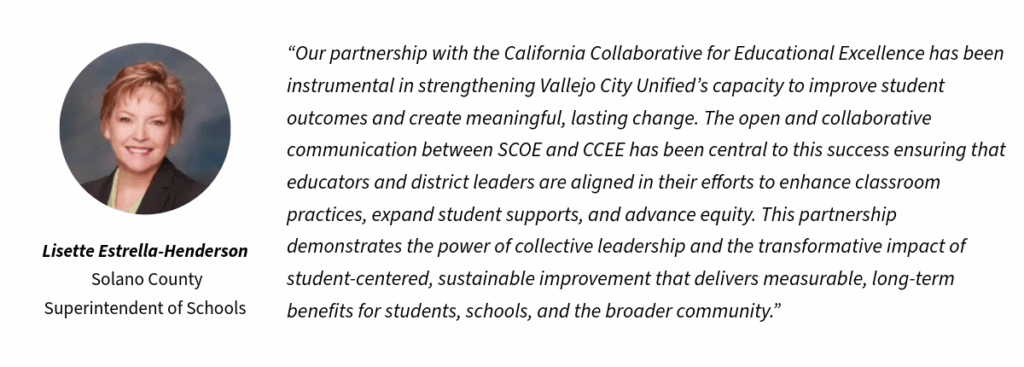
This collaboration will continue as the team supports the district’s ongoing efforts to improve student academic outcomes through continuous improvement.
Below is an AI-generated podcast version of this Hot Topic for those who prefer audio. Listen in for a quick, narrated overview of the story.
For additional updates, visit the CCEE website, events calendar, Resource Center, and the Statewide System of Support Website.
Hot Topics: Advocating for Equity Through Brave Leadership and Data-Informed Practice in the African American Student Success Network
The African American Student Success Network (AASSN), a partnership between the California Collaborative for Educational Excellence (CCEE) and the California Association of African-American Superintendents and Administrators (CAAASA), is entering its third year of supporting LEAs in advancing equity for Black students.
Through cross-district collaboration, evidence-based strategies, and the strategic use of data, AASSN empowers educational leaders to identify and dismantle systemic barriers that impact African American student outcomes. At the recent 2025 CAAASA Summit, participating districts showcased bold, equity-centered work, highlighting efforts to reduce disproportionality, improve engagement, and elevate student and family voice.
To support continued learning and impact, the network has released two new resources: a presentation slide deck featuring district case studies, and a session handout summarizing core strategies.
Together, we are building the capacity for transformational change, grounded in brave leadership and a commitment to student success. To learn more and access resources, visit the African American Student Success Network resource page.
For additional updates, visit the CCEE website, events calendar, Resource Center, and the Statewide System of Support Website.
Notice of Intention to Amend the Conflict of Interest Code for the CCEE

Notice of Intention to Amend the Conflict of Interest Code of the California Collaborative for Educational Excellence
NOTICE IS HEREBY GIVEN that the California Collaborative for Educational Excellence (“CCEE”), pursuant to the authority vested in it by section 87306 of the Government Code, proposes amendment to its conflict of interest code. A comment period has been established commencing on February 14, 2025, and closing on March 31, 2025. All inquiries should be directed to the contact
listed below.
The CCEE proposes to amend its conflict of interest code to include employee positions that involve the making or participation in the making of decisions that may foreseeably have a material effect on any financial interest, as set forth in subdivision (a) of section 87302 of the Government Code. The amendment carries out the purposes of the law and no other alternative would do so and be less burdensome to affected persons.
Changes to the conflict of interest code include: (1) addition of two new positions–Executive Advisor and Senior Advisor positions each of which has disclosure categories 1, 2, 3, 4, (2) removal of the three Director positions which no longer exist, along with their disclosure categories–Director, Systems Improvement and Innovation; Director, Systems Improvement and Leadership Development; and Director, Continuous Improvement, and (3) revising the language defining “Administrative Agent” to be consistent with the relevant statute and requirements for selection and approval of the Administrative Agent.
The proposed amendment and explanation of the reasons can be obtained from the agency’s contact.
Any interested person may submit written comments relating to the proposed amendment by submitting them no later than March 31, 2025, or at the conclusion of the public hearing, if requested, whichever comes later. At this time, no public hearing is scheduled. A person may request a hearing
no later than March 16, 2025.
The CCEE has determined that the proposed amendments:
- Impose no mandate on local agencies or school districts.
2. Impose no costs or savings on any state agency.
3. Impose no costs on any local agency or school district that are required to be
reimbursed under Part 7 (commencing with Section 17500) of Division 4 of Title 2 of
the Government Code.
4. Will not result in any nondiscretionary costs or savings to local agencies.
5. Will not result in any costs or savings in federal funding to the state.
6. Will not have any potential cost impact on private persons, businesses or small businesses.
All inquiries concerning this proposed amendment and any communication required by this notice should be directed to: Leighann Nguyen, Executive Assistant, (916) 619-7488, [email protected].
Hot Topics: Empowering Inclusive Education with the UDL Data Toolkit
As educators, our ultimate goal is to ensure that every student thrives in an environment tailored to their diverse needs. The Universal Design for Learning (UDL) framework provides a transformative approach to fostering inclusivity and equity. To support this mission, we are thrilled to introduce the UDL Data Toolkit—a comprehensive resource designed to help educators measure, monitor, and refine their UDL implementation with precision and purpose.
The UDL Data Toolkit, collaboratively developed with partners like Riverside County Office of Education, Placer County SELPA, and WestEd, equips local educational agencies (LEAs) with tools and strategies to create effective learning environments for all students. By using this resource, educational leaders can not only measure the impact of UDL but also ensure alignment with broader district priorities such as equity, inclusion, and continuous improvement.
Key Features of the UDL Data Toolkit:
- Comprehensive Data Collection: The toolkit provides structured guidance on collecting data across students, educators, leaders, and systems, offering a holistic view of UDL implementation.
- Multiple Levels of Data Analysis: From district-wide trends (large grain) to classroom-level insights (fine grain), this resource ensures actionable data at every level.
- Practical Tools and Resources: Includes no-cost assets such as surveys, rubrics, observation tools, and self-assessments tailored to diverse educational settings.
- Focus on Data Ethics and Privacy: Aligns with best practices to ensure data governance and student privacy while fostering transparency and trust.
This resource exemplifies the commitment of the Statewide System of Support to empower educators with practical tools for real-world challenges. By integrating data-driven strategies with UDL principles, this toolkit helps schools create learning environments where every student can succeed academically, behaviorally, and socio-emotionally.
We invite educators to take advantage of this robust resource to refine their UDL practices and drive meaningful change in their schools and districts. Together, let’s embrace the power of data to create inclusive and equitable education for all.
For more information or assistance, please visit our website. Stay connected for updates and upcoming resources via our events calendar and the Statewide System of Support Resource Hub.
Hot Topics: Streamlining Assessment Systems for Better Educational Outcomes
As the Executive Director of the California Collaborative for Educational Excellence (CCEE), I am excited to continue sharing our strategic priorities for the 2024-2025 school year, including our focus on utilizing data to maximize impacts for students statewide. Our goal is to refine data collection processes, develop clear measurable objectives tied to all initiatives, and leverage advanced analytics to identify trends and areas for improvement. This ensures every initiative has clarity on and access to data that drives meaningful outcomes. Through focused data-driven insights, we can support LEAs in addressing their unique challenges, fostering a culture of continuous improvement across the state. One crucial area in this effort is the streamlining of assessment systems to improve educational decision-making and outcomes.
Overview:
Assessment systems play a pivotal role in shaping the quality of education, yet they can often become cluttered and inefficient. Over-assessment, duplicative evaluations, and misaligned approaches can burden educators and students alike, leading to a loss of valuable instructional time. To address these challenges, it is essential to adopt a balanced assessment system—one that delivers diverse, meaningful data to inform educational decisions while freeing up time for teaching and learning.
Solution:
The Assessment System Review online learning path, developed in collaboration with the National Center for the Improvement of Educational Assessment, offers educators a structured approach to evaluate and refine their assessment practices. This learning path provides the knowledge, skills, and tools needed to conduct a thorough review of all assessments students complete throughout the year.
The learning path is broken into six modules:
- Module 0: Introduction to the Learning Pathway
- Module 1: Prepare to Launch
Module 2: Clarify the Instructional Vision - Module 3: Reflect on Assessment System Needs
Module 4: Conduct the Inventory - Module 5: Evaluate the Inventory of Assessments & Write Recommendations
- Module 6: Create an Action Plan
These modules guide teams through a detailed process, helping educators identify areas of over-assessment, ensure assessments serve the right purpose, and optimize instructional time. The flexible format allows teams to move at their own pace and adapt the learning path to meet their specific needs.
Call to Action:
Empower your school or district by embarking on the Assessment System Review Learning Path. Begin your journey today and start making informed, data-driven decisions that enhance student learning experiences. Visit the learning path for more details.
Stay tuned for more updates on how CCEE is supporting educators statewide in leveraging data for improved educational outcomes.
Development and Delivery of Resources and Services to Support CCEE Communication Activities
DESCRIPTION
The California Collaborative for Educational Excellence (CCEE) and the Marin County Office of Education (MCOE) are issuing this Request for Proposals (RFP) to seek qualified organizations to develop and deliver communication resources and services. These resources will support CCEE’s strategic communication goals, focusing on increasing awareness of CCEE’s offerings, elevating its value as a partner to local educational agencies (LEAs), and building deeper relationships within the California TK-12 education community.
This RFP invites proposals that address the following areas:
- Digital Presence and Content: Creation and management of web and social media content, search engine optimization, and the development of microsites to enhance CCEE’s digital footprint.
- Outreach and Engagement: Strategies to engage LEAs, educational partners, and other stakeholders through newsletters, email campaigns, and direct outreach.
- Events and Workshops: Planning and coordinating events such as webinars, workshops, and open-door sessions that facilitate stakeholder collaboration and knowledge sharing.
- Reporting and Analysis: Development of reports, impact statements, and analysis of communication efforts to measure their effectiveness and alignment with CCEE’s goals.
- Support and Feedback: Tools and methods to gather feedback, assess stakeholder needs, and improve communication strategies based on that feedback.
The selected Respondent will collaborate with CCEE staff to design, implement, and evaluate communication strategies that align with CCEE’s Theory of Action and strategic objectives.
Proposals Accepted Through: Thursday, May 1, 2025, at 4:00 p.m. PST
REQUEST FOR PROPOSALS (RFP)
QUESTIONS FROM RESPONDENTS (Post Date: Friday, August 16, 2024)
Point of Contact: Sehrish Anjum ([email protected])
Last Updated: Wednesday, January 29, 2025
Hot Topics: Addressing Chronic Absenteeism in California Schools
Chronic Absenteeism poses a significant challenges in California. This Hot Topic highlights successful strategies from the CCEE Bright Spots Fact Sheet and Attendance Works to address this issue effectively.
Key Highlights from CCEE Bright Spots:
- Supportive Leadership: Principals lead cross-departmental teams to tackle attendance barriers.
- Strategic Data Use: Real-time attendance data drives proactive support for students and families.
- Building Trust: Developing trusting relationships between schools and families fosters a supportive environment.
- Clear Guidance: Clear health and attendance guidelines help reduce health-related absences.
Key Strategies from Attendance Works:
- Identify Barriers: Use data to identify and address systemic barriers affecting attendance.
- Understand Root Causes: Analyze factors contributing to absenteeism using qualitative and quantitative data.
- Targeted Interventions:
- Safe Routes: Ensure safe routes to school to mitigate neighborhood dangers.
- Classroom Breakfast: Implement breakfast programs to improve attendance.
- Afterschool Programs: Provide access to quality afterschool programs.
- Recess Programs: Utilize recess interventions to reduce behavioral issues
Call to Action: Review the findings from the Bright Spots Fact Sheet and Attendance Works resources. Implement these strategies to foster an environment that supports regular attendance and academic success.
For more information, refer to the Bright Spots Fact Sheet and Attendance Works Guide.
If you have any questions about CCEE and how to engage with our resources and professional learning opportunities, please visit our website. Stay Ahead in Education! 📚 Check out our Podcast Rising from the Margins, Statewide System of Support Directory, and Friday 5! Join CCEE’s ListServ & Calendar Updates to Never Miss an Event. Sign Up Now for Limitless Learning Opportunities. 🌟 #CCEEConnections”