Hot Topics: Using UDL to Support Differentiated Assistance

As districts across California receive their Differentiated Assistance determinations, and some enter Direct Technical Assistance, now is a critical moment to connect with the universal and targeted supports available through the Statewide System of Support. One powerful resource is Open Access, which partners with LEAs to strengthen Universal Design for Learning (UDL) implementation and build equitable, data-driven systems that improve outcomes for all learners.

Morongo Unified School District’s story offers a compelling example of how intentional structures, coaching, and collaboration can translate system-level goals into measurable progress. Through its work with Open Access, the district has expanded UDL implementation across school sites, strengthened instructional rounds, and deepened shared ownership for student success. These efforts are especially vital as the district focuses on improving outcomes for student groups experiencing persistent low performance, including African American students, foster youth, homeless youth, and students with disabilities.

This upcoming CCEE Open Door session provides an opportunity for LEAs (especially those newly identified for DA/DTA) to see firsthand how universal tools, targeted coaching, and statewide supports can help accelerate improvement. With free resources such as the CCEE UDL Data Toolkit, the Open Access UDL Lesson Planning Toolkit, perception surveys, and instructional round protocols, LEA teams can begin using high-leverage strategies immediately. This is an open invitation for all LEAs to learn, connect, and take action.

Open Door Learning Session

Hosted by the California Collaborative for Educational Excellence (CCEE)
From Access to Action: Morongo Unified’s Journey Through the Statewide System of Support

To learn more about CCEE, please visit our website, review the CCEE Annual Report, statewide evaluations, statewide maps, and the Statewide System of Support.

Hot Topics: California SBE’s Portrait of a Graduate/Learner

California State Board of Education (SBE) is developing its a Portrait of a Graduate/Learner to support what every California student should know and be able to do when they leave school. This Portrait will not create new requirements for districts. Instead, it will help guide the State Board’s decisions on curriculum, assessment, and accountability.

To shape this vision, the SBE is inviting voices from across California to share their ideas through a community survey and upcoming in-person and virtual conversations. Your input will help ensure that the Portrait reflects the diverse hopes and experiences of California’s students, families, and educators.

In addition to the survey effort, the State Board will be collecting feedback from in-person and virtual conversations with a diverse set of stakeholders from across California. If you have questions or comments about this effort, please reach out to a team member of the State System of Support at [email protected].

Resources

For additional information, contact Dr. Christine Olmstead, Secondary School Redesign & DTA Lead (via OCDE Agreement with CCEE), at [email protected].

To learn more about CCEE, please visit our website, review the CCEE Annual Report, statewide evaluations, statewide maps, and the Statewide System of Support.

Hot Topics: Expanding Access to High Quality Lessons Through HQOIM

The High Quality Online Instructional Materials (HQOIM) initiative, led by the Kern County Superintendent of Schools (KCSOS), is a strategic investment in improving instructional quality and student outcomes. With support from the California Department of Education (CDE) and evaluation guidance from WestEd and the California Collaborative for Educational Excellence (CCEE), the initiative ensures that high-quality, standards-aligned digital lessons are accessible to educators via California Educators Together, a platform designed to meet teachers where they are.

KCSOS designed a comprehensive, sustainable professional learning program that evolved from high-cost institutes into a diversified approach, including:

  • Lesson Design Institutes (LDIs)
  • Workshops
  • Asynchronous online courses

These offerings have supported over 1,900 educators across the state, with specialized efforts targeting:

  • Rural and remote communities
  • Deaf and hard of hearing education
  • Subject-specific lesson development

Educator feedback highlighted the value and practicality of the training received.

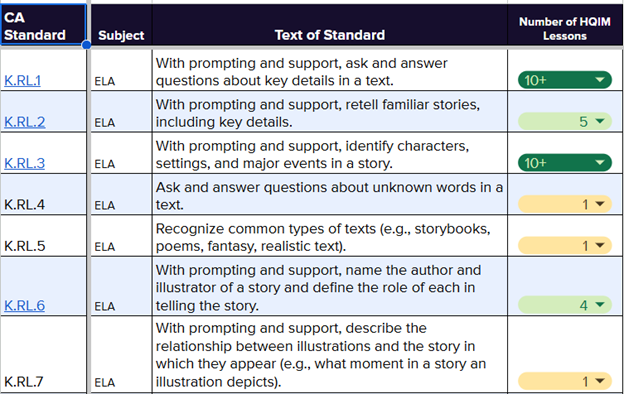
To maintain focus on rigor and alignment, KCSOS developed an internal tracking tool to monitor the number of vetted lessons, their alignment to California state standards, and gaps in coverage. Teachers were incentivized to prioritize underrepresented standards and content areas.

As a result, the HQOIM initiative has developed lessons covering approximately 42% of California’s state standards, significantly advancing state-level instructional coherence, and the availability of equitable, high-quality instructional materials. Below is a depiction of the tracker and the progress achieved in TK-K ELA standards.

The state support for HQOIM has marked an important shift toward engaging educators more meaningfully in the adoption of instructional materials aligned with California standards and compliments large scale vetting efforts to improve instructional materials. To learn more about the development of standards aligned materials developed through HQOIM, click on the video library and CA Educators Together podcast below.

Stay tuned as we spotlight more stories from across California, with the next feature highlighting the HQOIM mathematics lessons, as CA prepares for its mathematics instructional materials adoption.

To learn more about CCEE, please visit our website, review the CCEE Annual Report, statewide evaluations, statewide maps, and the Statewide System of Support.

Hot Topics: CA High Quality Online Instructional Materials Initiative Legislative Report

California’s High Quality Online Instructional Materials (HQOIM) initiative, launched in 2021 through Assembly Bill 167, has successfully expanded equitable access to standards-aligned educational resources across the state. Over three years, led by the Kern County Superintendent of Schools, the program has developed more than 6,000 vetted lessons covering 43% of California standards, registered over 200,000 educators on the California Educators Together (CaET) platform with engagement more than doubling since 2023, and saved the state $10 million by leveraging existing infrastructure. The initiative has provided targeted professional development to 1,900+ educators and reached rural districts, English learner programs, and specialized populations.

With evolving expectations that HQOIM support instruction that is factually accurate and aligned to state-adopted curriculum and standards, the need for a centralized, free platform where educators can reliably access high-quality instructional materials has never been more urgent. This platform must uphold the professional standards of K–12 education, and remain rooted in evidence-based practices and not shaped by advocacy, personal opinion, or partisanship.

Yet, without sustained annual funding, California stands to lose this proven, cost-effective infrastructure, an asset that has already positioned the state as a national leader in the development and distribution of high-quality instructional content.

To learn more about the HQOIM initiative and its demonstrated impact, please refer to the required legislative report.

Learn more about CCEE by visiting our website and exploring the Annual Report, statewide evaluations, statewide maps, and the Statewide System of Support.

Hot Topics: Secondary School Redesign Pilot Program

The Secondary School Redesign Pilot Program establishes a $10 million initiative to develop and support innovative models for middle and high school redesign that promote strong relationships, deeper learning, personalized supports, and pupil engagement. The California Collaborative for Educational Excellence will lead the program, select grantees, manage peer learning, and evaluate outcomes for statewide application. Participating schools and LEAs must commit to a two-year redesign effort and share data to inform sustainable, equitable improvements.

Important Dates:

  • RFP Launch: September 15, 2025
  • Eligibility and Pilot Overview Webinar: September 18, 2025 12PM PT
  • Eligibility and Application Overview Webinar: October 9, 2025 12PM PT
  • Application Deadline: October 17, 2025 4PM PT
  • Selection Notification: October 24, 2025

For additional information, review the CCEE Annual Report, visit the CCEE statewide evaluations webpage, statewide maps, and the Statewide System of Support.

Hot Topics: Join California’s GENIUS Initiative

California’s Genuine Empathy Nurturing Intellect for Underserved Students (GENIUS) Initiative is now accepting applications from schools ready to tackle educational disparities head-on. This statewide program, led by Los Angeles, Kings, and Sonoma County Offices of Education, provides targeted support to build more inclusive learning environments where every student can thrive.

What GENIUS Offers

Schools selected for the program gain access to specialized tiered support, high-impact professional learning opportunities, expert coaching, and Communities of Practice. Most importantly, they join a collaborative network of educators committed to closing equity gaps across California.

Application Details

Who Can Apply: All PreK-12 public schools and charter schools are eligible, with priority given to schools receiving Equity Multiplier Funding.  

Key Requirements: Participating schools must commit to building belonging, partnering with GENIUS Leads on data-driven improvements, engaging in professional learning and coaching, and securing district leadership support.

Important Dates:

  • Program Launch: Fall 2025
  • Application Deadline: September 5, 2025, 11:59 PM PT
  • Selection Notification: October 2025

Upcoming GENIUS Event

Don’t miss the “Transforming Lives: Nurturing Seeds of Genius” conference in Fresno, CA, September 8-9, 2025. This two-day event features expert sessions on cultivating inclusive environments and supporting youth reentry transitions, offering practical strategies for empowering at-promise youth.

Register: kings.k12oms.org/89-264685

For additional information, review the CCEE Annual Report, visit the CCEE statewide evaluations webpage, statewide maps, and the Statewide System of Support.

Hot Topics: Collaborating with Solano COE and Vallejo City USD for Sustainable Change

In Spring 2025, Vallejo City Unified School District (VCUSD) regained full local control of its schools after more than two decades under state receivership, a milestone that marks the culmination of deep-rooted, sustained efforts led by the Solano County Office of Education (SCOE), the California Collaborative for Educational Excellence (CCEE), and VCUSD. Their shared goal: build systems that prioritize equity, transparency, and outcomes for students most in need.

This powerful partnership exemplifies what is possible when agencies align around student-centered values and a shared theory of action. Their journey showcases the core values of Collaboration, Clarity, and Courage, values that guided every step of their work to rebuild trust, shift mindsets, and strengthen systems from within.

Building a Foundation for Local Control

VCUSD’s journey from fiscal crisis to local governance began with a bold step in 2018, when SCOE referred the district for CCEE’s Direct Technical Assistance (DTA). This move catalyzed a transformative partnership, allowing for the creation of cross-functional teams, aligned leadership structures, and data practices that focused on inquiry and improvement.

Superintendent Lisette Estrella-Henderson, who is retiring after more than 40 years in education, played a pivotal role. Her leadership helped solidify a countywide vision for supporting Vallejo, one rooted in collective responsibility and a belief in the potential of every student.

A Culture Shift: From Data Gaps to Shared Accountability

With new leadership, including VCUSD Superintendent Rubén Aurelio came renewed efforts to build a culture of trust and learning. SCOE and CCEE supported the development of structures that empowered school leaders, elevated teacher voice, and reestablished data as a tool for equity rather than compliance.

Key efforts included aligning site leadership teams, investing in the capacity of central office staff, and expanding professional learning through CCEE’s Superintendent Professional Learning Network. As a result, leaders across the district began using data collaboratively to drive improvement and build shared accountability for student success.

IAM in Action: Transforming a School, Inspiring a District

One standout example of this work is Federal Terrace Elementary School, a participant in CCEE’s Intensive Assistance Model (IAM). By implementing the Professional Learning Community (PLC) at Work framework, Federal Terrace fostered a culture of teacher leadership, targeted instruction, and student-centered decision-making.

The results speak for themselves: the school now has the highest kindergarten reading scores in the district. More importantly, the model created a replicable structure of success that VCUSD is working to scale districtwide.

Sustainable Change, Enduring Impact

VCUSD’s fiscal recovery required difficult decisions, including school closures and budget cuts but was anchored by a commitment to preserving the academic core. Through it all, the district’s partnership with SCOE and CCEE ensured that decisions were informed by data and aligned with long-term goals for equity and excellence. This collaboration will continue as the team supports the district’s ongoing efforts to improve student academic outcomes through continuous improvement.

As Superintendent Estrella-Henderson transitions into retirement, her legacy is visible in the systems, partnerships, and trust built throughout this journey. The collaborative work in Solano County stands as a beacon for what sustainable change can look like when state, county, and local agencies move together with shared purpose.

This collaboration will continue as the team supports the district’s ongoing efforts to improve student academic outcomes through continuous improvement.

Below is an AI-generated podcast version of this Hot Topic for those who prefer audio. Listen in for a quick, narrated overview of the story.

For additional updates, visit the CCEE websiteevents calendarResource Center, and the Statewide System of Support Website.
Hot Topics: CCEE Priorities for 2025–2026 – Driving Integration and Impact

As we move into the 2025–2026 school year, the California Collaborative for Educational Excellence (CCEE) is sharpening its focus on integration and measurable impact across statewide educational efforts within the Statewide System of Support.  In partnership with state agencies and the Statewide System of Support (SSOS), our work will center on four priority areas: data for impact, special education integration, mathematics coherence, and a unified literacy network focused on integration/impact. These priorities reflect our commitment to advancing coherence, accelerating student outcomes, and building capacity across systems.

1. Data for Impact

We are aligning internal and external data efforts to improve decision-making, measure the effectiveness of our support, and provide actionable insights to LEAs. By integrating data use across SSOS partners, we aim to strengthen continuous improvement efforts and drive systemic change.

2. Special Education Integration

CCEE is designing in partnership with our state partners targeted and intensive models of support for LEAs for improved outcomes for students with disabilities. Through the District State Study Team Model, we will work to develop in collaboration with statewide partners alignment, coherence, and integration within SSOS, enabling LEAs to better meet the diverse needs of their students.

3. Statewide Mathematics Coherence

In collaboration with state-funded math leads and the California Department of Education, we will coordinate universal resources and professional learning supports aligned with the new math framework. This work will unify math implementation efforts and increase statewide access to high-quality instructional tools.

4. Unified Literacy Network

CCEE will partner with the CDE and statewide literacy leads to create a more cohesive approach to literacy initiatives. Through coordinated messaging, shared resources, and streamlined supports, we aim to improve access, alignment, and outcomes in literacy instruction across California

Our Commitment

By aligning initiatives, integrating resources, and foster stronger collaboration across systems, CCEE remains focused on delivering high-impact support that advances educational equity and excellence for every student in California.

For additional information, review the CCEE Annual Report, visit the CCEE statewide evaluations webpage, statewide maps, and the Statewide System of Support.

Hot Topics: Highlights from the 2024/25 CCEE Annual Report

The 2024/25 Annual Report from the California Collaborative for Educational Excellence (CCEE) highlights a year of impactful, equity-driven work across more than 528 local educational agencies—reaching 2.5 million students. Behind these numbers are real shifts: improved academic outcomes, stronger student engagement, and reductions in absenteeism and suspensions. Through over 40 targeted initiatives—like the African American Student Success Network, Data Literacy and Leadership Academy, and Direct Technical Assistance—CCEE demonstrates how strategic partnerships within the Statewide System of Support translate complex challenges into meaningful, measurable change.

What sets CCEE apart is its commitment to coherence and sustainability. By combining data-informed leadership with authentic community voice, it helps districts move beyond reactive cycles toward lasting transformation. Whether it’s rural schools implementing literacy interventions or urban systems rethinking student belonging, CCEE enables the kind of long-term capacity-building essential to making statewide initiatives—like Universal TK and Community Schools—work where it matters most: in classrooms and communities.

Call to Action:

Want the full story behind California’s education transformation? Download CCEE’s complete 2024-25 Annual Report to explore detailed case studies, outcome data, and innovative strategies that are reshaping how we support students. The data-driven insights and success stories offer essential context for understanding what’s working—and what’s possible—in California education.

For additional updates, visit the CCEE statewide evaluations webpage, statewide maps and the Statewide System of Support website.

Hot Topics: Why School District Turnaround Takes Time—and What CCEE Is Doing About It

Hot Topics: Why School District Turnaround Takes Time—and What CCEE Is Doing About It

Date: May 28, 2025

Turning around a school district isn’t a quick fix—it’s a journey that can span anywhere from 3 to 10 years, depending on local conditions. The video above explains what CCEE has come to understand in our work across California: transformation is deeply tied to the readiness and capacity of local leaders.

  • Willing and Able districts—those with strong leadership and a proactive mindset—can see meaningful change in as few as 3 to 5 years.
  • Others may be willing but lack capacity, requiring 5 to 7 years to build systems that support lasting improvement.
  • The journey gets longer for unwilling or under-resourced districts, where systemic challenges may push timelines to 8–10 years or more.

This variability isn’t theoretical—it’s what we see in the field every day.


CCEE’s Role in Direct Technical Assistance (DTA)

As part of California’s Statewide System of Support (SSOS), the California Collaborative for Educational Excellence (CCEE), in partnership with county offices of education, provides Direct Technical Assistance (DTA) to a small group of districts facing persistent, complex challenges.

Our role is unique:

  • We partner with districts and their respective county offices of education and geographic lead agencies to co-create strategies that reflect their context.
  • We embed support—from collaborative planning to intensive partnership—tailored to each district’s needs.
  • We act as thought partners, data facilitators, and connectors, linking districts with resources, expertise, and peer support.

But even with intensive support, turnaround is rarely quick. That’s because…


Why Improvement Takes Time

Transformation is not just about new programs—it’s about changing adult behavior, governance culture, and instructional systems. Districts may struggle with:

  • Leadership turnover
  • Weak board governance
  • Misalignment between plans and practice
  • Lack of internal capacity for data use and continuous improvement

Many LEAs are willing, but not yet equipped to move at scale. Others may resist change or prioritize local control over proven practices. This makes it essential to differentiate support based on readiness, not just performance indicators.

Fixing the System, Not Just the Symptoms

The current SSOS is stretched thin—too many districts qualify for support, while too few receive what they need to truly improve. CCEE is working with partners to address this through reforms that:

  • A Narrower focus of DTA/DA
  • Incentivize early intervention
  • Strengthen accountability and consultation
  • Clarify roles and expectations

Related Posts

Hot Topics: A Research-Grounded Approach to Supporting California’s Most Challenged Districts

California’s chronically underperforming districts face a compounding problem: the […]

Hot Topics: Introducing the New Frontline Voices Podcast

As CCEE launches the Frontline Voices Podcast, this Hot […]

Hot Topics: The PLC Shift That Delivers

H.W. Harkness Elementary returns to Rising From the Margins […]

Hot Topics: Launching the Ecosystem of Care Toolkit

Across California, county offices of education, health and human […]