CCEE Connection (April 2022)

News & Announcements
REQUEST FOR PROPOSALS

CCEE has posted Notices of Intent to Award for the following Requests for Proposals (RFPs). Please click on the links below to learn more about the anticipated grantees and awardees.

Learning Acceleration System Grant

Independent Evaluation Services for the High-Quality Online Instructional Materials Initiative

Independent Evaluation Services for the Reading Instruction & Intervention Initiative

Independent Evaluation Services for the Learning Acceleration System Grant

COMMUNITY ENGAGEMENT INITIATIVE

Interested in enhancing and expanding your district’s community engagement efforts? Join the Community Engagement Initiative (CEI)’s Cohort III Peer Leading and Learning Network (PLLN)!

Applications are due by Tuesday, May 17, 2022 at 9:00am. Interested districts can view FAQs, detailed application instructions, and a recorded information session at CaliforniaEngage.org/Cohort3

See what current partners are saying in the first edition of CEI’s Voices From the Field

2021-22 CCEE INDEPENDENT STUDY PROFESSIONAL LEARNING NETWORK (ISPLN)

Join CCEE and participating districts for solution-oriented discussions focused on a problem of practice around independent study.

Learn more about the ISPLN meetings.

Register for the next meeting on Monday, April 18, 2022.

IN CASE YOU MISSED IT

System of Support Updates (April 2022)

Statewide Instructional Modes Survey (AB 130) – Spring 2022 Updates (3/17/22)

Introduction to the UDL Journey Guide (3/23/22)

April Resources
CAAASA FIELD GUIDES

Developed in partnership with the California Association of African-American Superintendents & Administrators (CAAASA), the CAAASA Field Guides share the experiences and reflections of our students, teachers, parents, and families of color to serve as guides for how to better support our students when they return to the classroom.


CAAASA Field Guide 1: Transitioning Back to School with a Focus on Relationships
CAAASA Field Guide 2: Learning and Healing Together
CAAASA Field Guide 3: School Engagement
CAAASA Field Guide 4: Planning Forward with Cultural Relevance in the Classroom
CAAASA Field Guide 5: Integrating Empathy, Compassion and Restorative Justice in Our Schools
CAAASA Field Guide 6: Enhancing Parent Engagement for Student Success
CAAASA Field Guide 7: School Re-orientation for Post-COVID Learning
CAAASA Field Guide 8: Understanding the Most Critical Needs of Today’s African American Students (and Children from Other Communities of Color)
CAAASA Field Guide 9: Preparing African American (and Other Students of Color) for College
SUMMER GAME PLAN WORKSHOP SERIES

Join the Partnership for Children & Youth for its Summer Game Plan Workshop Series!  Designed for K-12 administrators, educators, and community partners, these workshops provide access to conversations with peers and nationally recognized experts, strategies to navigate the biggest challenges when planning your summer learning program, and resources to aid your planning. Register for upcoming workshops and watch past sessions on the Summer Game Plan website.

3RD ANNUAL CALIFORNIA COLLEGE AFFORDABILITY SUMMIT

Please join the California Student Aid Commission, the Education Trust West, and the Riverside County Office of Education for the 3rd Annual California College Affordability Summit. This event will be held virtually on April 20 and 21 from 9:00am–12:00pm each day.

The focus of this important event is to learn about the best practices and tools available to comply with the new FAFSA/CA Dream Act Application completion requirement. This event will include opening speakers, general sessions, and three breakout sessions.

The Summit will equip K-12 educators, high school counselors, college financial aid administrators, student advocates, and policy leaders with the information, resources, and tools at their disposal to be successful in the implementation of the new financial aid completion requirement for local educational agencies. This is a crucial time in California around its commitment to increase financial aid awareness and opportunities for low-income and first-generation students.

Session topics will cover the following areas:

  • Financial aid applications and resources
  • Best practices, engaging families, and building partnerships
  • Beyond the financial aid application

More information will be available soon. Please register for the 3rd Annual California College Affordability Summit to receive updates.

ABOUT THE CCEE

The California Collaborative for Educational Excellence is a statewide leader delivering on California’s promise of a quality, equitable education for every student.

Executive Director’s Corner
BUILDING CAPACITY IS NOT EASY!

I am always amazed at how quickly education uses the phrase “building capacity” to describe the work of improving and transforming systems. The act of building capacity has so many moving parts and is often grossly underestimated as the act of “getting better at getting better.”  However, I would ask us to reconsider just how intensive this work is, particularly at a systems level.  

Building capacity takes time — something not all parties are willing to wait for. Building capacity takes changes in approach, mindset, belief systems, and collective efficacy. Building capacity involves training, support, coaching, mentoring, self-regulated goal setting, improvement knowledge, research knowledge, and professional knowledge. Most importantly it is VERY, VERY time consuming and costly. Building capacity is about systems transformation and that is a costly endeavor of time, resources, and funding. 

Led by Deputy Executive Director Sujie Shin, CCEE’s Center for Innovation, Instruction, and Impact (I3) is charged to support our agency partners with the resources, knowledge, and expertise that support capacity building for the improvement of student outcomes. There is more than enough work to go around to keep everyone busy across the state for many, many years. Please see below for some highlights of the I3 Center on ways to enhance your professional and organizational capacity.

Sincerely,

Matt J. Navo
Executive Director,
CCEE

Coming Back Stronger in 2022

By Sujie Shin, Deputy Executive Director, CCEE

Headshot of Sujie Shin

A little more than two years after the Governor issued his historic stay-at-home order, grinding much of the world as we knew it to a halt, schools in California are now all back in person, and educational leaders across the state are grappling with how much of learning as we know it has changed. 

While there is much to be concerned about, as we address ongoing, and in some cases, growing disparities in rates of chronic absenteeism, graduation, and college-going, there is still reason to be hopeful. I’m encouraged by how many of our school communities have rallied to find innovative ways to encourage learning during a time when engagement in school has been at an all-time low. We’ve seen new and stronger community-based partnerships spring up to support student, family, and staff well-being. And we’ve seen greater investments statewide to support learning acceleration for all students.

As the Innovation, Instruction, and Impact (I3) Center within CCEE, our focus is to seek out and amplify these innovative strategies, best practices, and student-centered resources from educators and schools to expand access across the state. Aligned to CCEE’s Theory of Action, the I3 Center aims to increase access to high-quality, relevant, and usable tools, guidance, and resources to build LEA capacity in making evidence-based decisions that lead to improved student outcomes. In all three strands of our work, we link the development and vetting process with dissemination support to implement a statewide approach in sharing research and strategies that have demonstrated the power to improve outcomes for students.

One of our new initiatives I’d like to share is our work in developing what we are calling “microlearning modules.” In partnership with the California Subject Matter Projects, CCEE has begun to develop a series of very brief instructional videos featuring master teachers sharing immediately applicable strategies, ideas, and resources to support instruction and engagement for substitute teachers and other instructional staff who may not have access to more robust professional learning opportunities. These are not meant to introduce complex ideas or lessons, but to focus on a single resource or activity to support student learning in a variety of settings. 

As we work towards a Summer 2022 launch, we are hoping to find additional LEAs who are interested in partnering with CCEE to identify master teachers and instructional leaders to develop additional resources. District leaders who are interested in learning more and/or contributing are asked to submit an interest form.

More information about this initiative can be found on this flyer

Six Reasons for California to be Optimistic About Learning in 2022

By Michael Fullan, Professor Emeritus, Ontario Institute for Studies in Education at the University of Toronto & Co-Director, New Pedagogies for Deep Learning

Headshot of Michael Fullan

Thank you for the opportunity to put into the California context my Op-Ed piece on ’Six Reasons to be Optimistic About Learning in 2022’. Our team is heavily involved in the California well-being and learning agenda. California’s goals for the next four or more years are bold, deep, and ambitious. They tackle the ecology of system transformation: learning, community development, reducing poverty, early learning, always learning, well-being in daily life, robust equity, and more. 

Covid unwittingly has served up a giant opportunity for big change—a once-in-our-lifetimes chance for us to make substantial reform. There is one problem. Big change is always Janus-faced. Backward to disaster; forward to the thriving of society. Either is distinctly possible. Make the Six Reasons work for you; they can interact and have multiplicative impact. It is time to move away from the old grammar of a defunct system; to recognize and work with our best allies including those who might disagree at the outset; to make well-being and learning a 24/7 proposition; to immerse ourselves in the new spirit work and science of learning development; to foster diverse leadership working on the same big transformation; and sooner than later to realize that actual system change for the better has in fact come to pass. 

Above all, take action on each and every one of the Six Reasons. As you do this, make your circle of connections ever wider and focused. Create and sustain a web of system-wide actions that can withstand the storm of big change.

SIX REASONS TO BE OPTIMISTIC IN 2022 (PDF) 

SIX REASONS TO BE OPTIMISTIC IN 2022 (WEBINAR) 

The UDL Journey Guide

By James McKenna, Ed.D., Assistant Director, Professional Learning & Leadership Development, CCEE

Headshot of James McKenna

“CCEE transforms public education so that every student is inspired and prepared to thrive as their best self in the world.” That’s our vision. But what does it take to thrive in our modern world? Purpose, for one, has arisen as a key motivator in the workplace. Also, the ability to continuously learn and share that learning with others. Finally, the ability to think critically and strategically – to wrestle with ambiguity and come out on top. These are the traits our students need to be inspired and prepared to thrive. 

Universal Design for Learning (UDL) is a research-based framework for teaching and learning that intentionally builds each student’s capacity to be purposeful and motivated, knowledgeable and resourceful, and strategic and goal-directed. In other words, to inspire and prepare them to thrive. That’s why CCEE is committed to building capacity and coherence in our statewide systems to support implementation of Universal Design for Learning across California. 

On February 25th, CCEE launched the UDL Journey Guide, a website for district leaders and lead teams seeking to implement Universal Design for Learning in their schools. The UDL Journey Guide charts the path to implementation and connects users to the people waiting to help them. These include: statewide programs like the CA Coalition for Inclusive Literacy (CCIL), OpenAccess, and Supporting Inclusive Practices (SIP); county offices of education who offer training and coaching for UDL; and national leaders in UDL like the Center for Applied Special Technology (CAST), the founders of UDL. The guide also includes tools necessary for the journey, including self-assessments, look-fors, and more. 

As we at CCEE encounter more people and tools to share, we’ll add them to the Journey Guide. We’re also developing some resources ourselves, such as the UDL for School and District Leaders Learning Path and a growing showcase of videos, including the Plus One Approach, a great strategy for teachers to incrementally implement UDL in a way that is manageable and honors their autonomy and expertise. For more information on our UDL efforts, you can email [email protected]

Adapting Evidence-Based Tutoring Practices to Transform Student Learning

By Michelle Magyar, Ph.D., Senior Advisor, Policy Engagement & Impact Initiatives, CCEE

Headshot of Michelle Magyar

Local educational agencies (LEAs) that have historically confronted opportunity and achievement gaps under the best of circumstances continue to encounter exacerbated disparities that will impact students’ academic needs. The lingering effects of unfinished learning due to the pandemic leave students on average five months behind in mathematics and four months behind in reading by the end of the school year (e.g. McKinsey, 2021). These learning impacts disproportionately affect students of color and students from low-income communities with less access to resources to catch up.  

systematic review of randomized evaluations demonstrates tutoring programs consistently led to large improvements in learning outcomes for students (e.g., in some studies, an effect size greater than .3 or almost one year of additional learning). Recent research reveals high-impact tutoring can double or triple the amount of math high school students learn in one year. Finally, high-impact tutoring programs can relieve the pressures of teacher shortages and strengthen teacher pipelines by ensuring teacher candidates have exposure to teaching experiences. 

To support LEAs with designing, implementing, and evaluating high-impact tutoring programs, the CCEE, in collaboration with the CDE and SBE, co-hosted a series of learning sessions in partnership with Abdul Latif Jameel Poverty Action Lab (J-PAL) North America at MIT. Tutoring is most impactful when teachers or professionals (trained and paid) provide at least three sessions a week during the school day. The collaborative learning sessions assist LEAs with adapting the evidence-based practices of effective tutoring to meet local needs and expand the potential pool of tutors through the following areas:

CCEE will continue to co-host learning sessions to support institutes of higher education, local educational agencies, and community-based organizations collaboration on the implementation of evidence-based supplemental instructional programs and support services.

Coming Soon! J-PAL is offering a 10-part learning series on high-impact tutoring. For a sneak peek, you can review Module 2 Research Overview. Interested in joining a Learning Network to design and measure the impact of tutoring or need additional resources on high-impact tutoring? Connect with Michelle Magyar, Senior Advisor of Policy Engagement & Impact Initiatives at [email protected].

Center for Innovation,
Instruction, & Impact (I3)

The Center for Innovation, Instruction, & Impact (I3) implements a statewide approach to improving LEA capacity by collaboratively developing, delivering, sharing, and spotlighting practices that have demonstrated the power to improve outcomes for students.

Meet Our Newest I3 Team Members!

Allan and Italo are the newest additions to our I3 team! Hover over their pictures to learn more about what they do.

Allan Taing, Ph.D.

Senior Manager,
Research & Impact Analysis

Allan provides research, data analysis, and program evaluation support for the agency. He leads cycles of data-based inquiry and manages ongoing project development, evaluation, progress monitoring, and implementation activities.

Allan loves to travel and crossed Rapa Nui (Easter Island) off his bucket list a few years ago.

Italo Ciccarelli

Program Specialist,
Data & Impact

Italo provides project management support for I3 initiatives, coordinating activities across the portfolio of Center projects. He also provides research, data analytics, and visualization support for the team.

talo loves riding and collecting bicycles. He rides and races his bikes regularly throughout the week. 

CCEE Connection (February 2022)

DESCRIPTION

This month’s newsletter is brought to you by our Teaching, Learning, and Leading Center and some of the LEAs they work with. It highlights one of the unique pathways that Monterey County Office of Education is taking to inspire students to dream big. Solano County Office of Education and Vallejo City Unified School District take readers on their journey in Improvement Science. The newsletter also contains resources honoring Black History Month.

CCEE Connection (January 2022)

DESCRIPTION

Centered around social-emotional learning (SEL) and student wellness, this month’s newsletter features partner contributions from Santa Clara County Office of Education (SCCOE) and Butte County Office of Education (BCOE).

Carolyn Gray and Amanda Dickey from SCCOE write about how the county elevated student voice to open new student wellness centers at 12 local school sites. Sandra Azevedo from BCOE shares her reflections on leadership, systems, and social-emotional learning.

Resource Type

Reports & Publications

Type of Audience

Site Administrator / Instructional Coach, Systems Leadership, Teacher

Topic Area

Family and Community Engagement, Responsive Teaching & Learning, Social-Emotional Well-being

CCEE Connection (December 2021)

DESCRIPTION

Focused on technical assistance, this month’s newsletter features an article about technical opportunities that are available to help LEAs successfully access funds and implement programs to support all students, as well as a piece written by a student board member at Mt. Diablo Unified School District.

DOWNLOAD PDF 

VIEW PAST EDITIONS 

Resource Type

Reports & Publications

Type of Audience

Site Administrator / Instructional Coach, Systems Leadership

Topic Area

Governance, LCAP, Responsive Teaching & Learning

CCEE Connection (November 2021)

DESCRIPTION

Focused on addressing the teacher and staff shortages across the state, this month’s newsletter features partner contributions from the Commission on Teacher Credentialing (CTC) and Salinas UHSD. Learn about opportunities that are now available to help LEAs meet the need for teachers and substitutes, and how a California district filled their shortage of staff.

DOWNLOAD PDF 

VIEW PAST EDITIONS 

Resource Type

Blog, Reports & Publications

Type of Audience

Site Administrator / Instructional Coach, Systems Leadership, Teacher

Topic Area

Governance, Responsive Teaching & Learning

CCEE Connection (October 2021)

DESCRIPTION

This month’s newsletter will feature tools, strategies, and resources to reimagine how we engage families to improve student outcomes. Learn how California districts are transforming family-school partnerships and addressing the needs of their communities.

RESOURCE TYPE

Reports & Publications

TYPE OF AUDIENCE

Parent, Site Administrator / Instructional Coach, Systems Leadership, Teacher

TOPIC AREA

Family and Community Engagement, Responsive Teaching & Learning

CCEE Connection (September 2021)

DESCRIPTION

In this month’s newsletter, CCEE’s Executive Director, Matt J. Navo, shares his vision for California’s System of Support. It also features a partner contribution from Elise Yerkey, Implementation Specialist at CAST, who shares how educators can leverage the System of Support to promote literacy.

RESOURCE TYPE

Reports & Publications

TYPE OF AUDIENCE

Site Administrator / Instructional Coach, Systems Leadership, Teacher

TOPIC AREA

English Learners, Equity, Responsive Teaching & Learning, Social-Emotional Well-being

KEYWORDS

Literacy, System of Support

CCEE Connection (August 2021)

DESCRIPTION

CCEE’s new Executive Director, Matt J. Navo, discusses how he plans to lead CCEE in its efforts to accelerate learning and advance equitable outcomes for all students. Deputy Executive Director Sujie Shin also introduces CCEE’s new Playbook for Accelerated Learning (PAL).

RESOURCE TYPE

Reports & Publications

TYPE OF AUDIENCE

Site Administrator / Instructional Coach, Systems Leadership, Teacher

TOPIC AREA

Equity, Responsive Teaching & Learning, Social-Emotional Well-being

KEYWORDS

Accelerated Learning

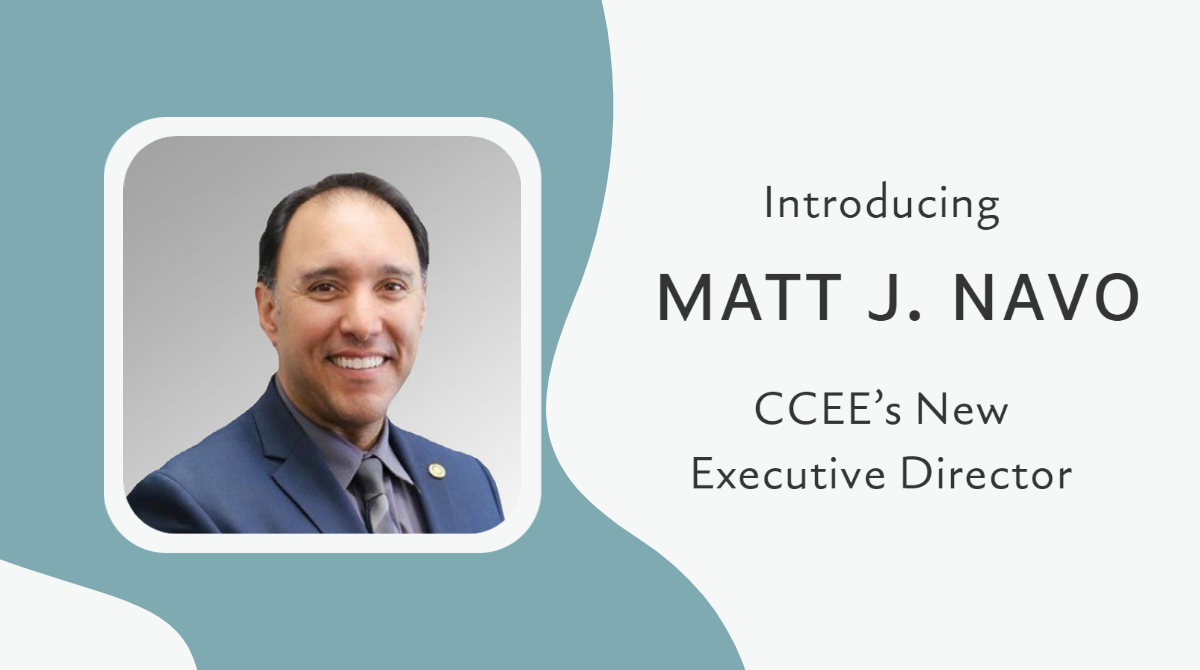
Introducing Matt J. Navo, CCEE’s New Executive Director

DESCRIPTION

Dorcas Kong, Senior Specialist, interviewed CCEE’s new Executive Director, Matt J. Navo, about how he plans to lead CCEE in its efforts to accelerate learning and advance equitable outcomes for all students.

Please note that the interview was edited for clarity and length.

INTERVIEW PANEL

Matt J. Navo, Executive Director, CCEE

Dorcas Kong, Senior Specialist, Executive Projects, CCEE

Could you tell us about your background and experiences that prepared you for your new role?

I had the opportunity to work in various educational settings. I started as a fifth-grade teacher when I was 21 and a half years old. I had no student teaching experience, but it was at a time when you could do that sort of thing. A principal, a good friend of mine, said, “I’ve got a great opportunity for you. The class only has five students.” And at that point, I didn’t know much about education, other than I wanted to be an elementary school teacher so I said, “Oh my god, that sounds amazing.” I was placed in that class the following year and it ended up being an SDC, a special day class, 4th-6th grade combo, in my second year of teaching. And I was shocked and had the anxiety that came with not knowing anything about special education. I went back to school and got my master’s degree in special education. Every job subsequently after was connected to serving students with special needs. And that’s where every opportunity that I’ve had as an educator has come from — serving students with special needs.

I had an opportunity to go to Sanger Unified School District in 1999. At that time, there were a lot of stories about Sanger Unified and how it was not a place that people were aspiring to go and learn, build a career, or raise a family. But that’s where I got a lot of my experiences. It was incredibly difficult, but it was also incredibly rewarding to be a part of a system that transformed itself over time. I was an administrator for a junior high school and a counselor at the high school level. In 2013, I became the superintendent of Sanger Unified. And then slowly but surely, a myriad of experiences opened for me because I was serving students with disabilities.

The first opportunity I had to serve at the pleasure of the governor, was as Governor Brown’s appointee on the Advisory Commission on Special Education (ACSE). They were looking for a superintendent that had special education experience. And shortly after that, the Special Education Task Force was curating a committee and wanted a district superintendent with special education experience. So I had the opportunity to serve Maureen Burness, Vicki Barber, and Carl Cohn, as the chair of the Evidence-Based Practices Subcommittee for the Special Education Task Force report.

After that, opportunities kept opening to serve at the pleasure of the governor with a special education emphasis. I was able to serve on CPAG, which was the California Practitioners Advisory Group and then Governor Brown appointed me to serve on the CCEE Governing Board in 2015. I served as the superintendent representative until I left the superintendency and ultimately, that opened the door to serve on the State Board of Education because you can’t serve on the State Board if you’re a superintendent as it’s considered a conflict of interest.

All of a sudden, I wasn’t a superintendent and yet had all of the experiences that they were looking for on the State Board. My name crossed Governor Newsom’s desk and he tapped me to sit represent him on the State Board of Education. That all happened because I was not a superintendent and then lo and behold, because I’m on the state board, Board Chair Linda Darling-Hammond board chair, in the garden, Hammond asked me to chair the CCEE Governing Board, which I had served previously. So it has all kind of come full circle. All these circumstances are serendipitous and coincidental. But really, from the moment I was asked to take on the class with five students… Had I asked any more questions, I probably would have said no. But I didn’t. I was simply that gullible — 21 and a half years old, aspiring teacher willing to do whatever. And I said, “Sure, I’ll do it.” I didn’t know I was going to have to go back to school, get my special education learning handicap credential, get my master’s degree.

As I left the superintendency, WestEd was kind enough and interested enough in my experience to ask me to serve as Director of Systems Transformation. I had three buckets of work in that role that really helped me grow during the last three years. Part of my responsibilities included serving the state of California as a State Board member and as the CCEE Governing Board Chair. I was also the co-lead of the National Center for Systemic Improvement (NCSI). I worked with 28 states, helping them think through how to improve their low performing school systems. And then the final bucket of work was district one. I worked with local districts to improve outcomes for students, with an emphasis on students with disabilities.

In the fall, LEAs will be addressing the learning gaps exacerbated by the COVID-19 pandemic. Based on your experiences, do you have any best practices or lessons learned you would like to share with LEAs?

No matter how we talk about it, at a systems level, it all comes down to the interaction between a teacher and student. It doesn’t matter if the state curates a great plan to accelerate learning unless it translates to a change, interaction, innovation, or redesign in how teachers help students acquire the learning they need. So we have to speak about accelerated learning in a way that clearly paints a picture of what we are asking the system to do differently in thinking about teaching and learning and those teacher-student interactions. What are we asking [teachers] to do? What do [students] need to know and be able to do? How does the system help them do that?

And that’s the challenge — that thinking has to translate through a system to get to that teacher-student interaction so there’s a lot of telephone game that plays out. We have to change the hearts and minds around how we think about accelerating learning and teaching and learning at a state level. And then we have to change the hearts and minds at a county office level and then change the hearts and minds at a superintendent level. And then he or she has to change the hearts and minds at a school principal level. And then that principal has to change the hearts and minds of teachers. There’s a lot of layers within that system and a lot of ways for our work to be diluted. What comes out may be completely different than what we had intended. So I think the system has to be really clear when it speaks of accelerated learning. What does that actually mean? What behaviors do we actually intend to enhance?  And we have to ask teachers, what is it that they mean? The closer we are to the boots on the ground, the better off we are.

Accelerated learning reframes the way we think about getting students to grade-level. What are some considerations for LEAs to keep in mind?

Accelerating student learning is not a new thing for us. It should have always been a part of the equation. Students who are struggling cannot be achieving at the same rate as everybody else. The gap will always exist. That’s why teachers will ask, “Why are we talking about this now? We’re always talking about accelerating student learning. This is what we do.” So what is it that we need to do differently? It comes down to a number of nuances in a school system. Do we have a high-quality instructional framework that we’re using across our system? Are we using formative assessments on a frequent basis to assess where students are? Do we have a scope and sequence or a pacing chart? Are we going to adapt the scope, sequence, and pace to review items more deeply? All those nuances come down to the broader questions— What is it that systems highly focused on teaching and learning do? And then what does the classroom teacher have to do, specifically related to teaching and learning? Because if you tell a teacher that they need to focus on accelerating learning, they’re going to say that they’ve already been doing that.

LEAs have to ask themselves, “What does an organization that is focused on student learning prioritize?” And one of the first things that will jump out to most people is student data. So a system should ask itself, “Do we have the ability to talk about student data? Do we have student data? Can we pull the data the way we need to? Does it prioritize our discussions across the system, at the school-site level and at the district level? If so, that system is highly collaborative and highly focused on student learning. Not only can they talk about student data, but they can also prioritize the data and actually use it in cycles of continuous improvement. How are we thinking about data and continuous improvement? Do we have a tiered support system? Do we have universal screeners? Do we know where all kids are? What does the research say about systems focused on student learning? Those are the things that teachers, administrators, and leaders can talk about.

How might LEA leaders engage their teams in developing a learning acceleration plan to ensure understanding and buy-in from across the organization?

In systems work, there’s a theory called being on the edge of the inside. What this means is that you can often be on the edge of the inside without being on the inside. The analogy is, let’s say you’re driving across the Bay Bridge to go into San Francisco at night and you see these beautiful lights in the city. It gives you this euphoria of going into something that’s going to be magical and beautiful but when you get into the alleys of the city, they look really different than the illusion you saw.

At the National Center for Systems Improvement (NCSI), we would remind state level leaders that just because they did something, it doesn’t mean it was translated into the right work. Oftentimes, they’re seeing an illusion. So as a leader, the only way to get off the edge of the inside is to fight that mentality and get into the alleys to see what’s happening — see the graffiti, see the poverty, see the dirt, and see the mess. Then, you can start figuring out if what you’re seeing is actually what it is. It’s the same thing for accelerated learning. If we don’t tap the user’s perspective, we will be sitting on the edge of the inside for a long time.

How do you see CCEE leading the work as a lead state agency to accelerate learning and advance equitable outcomes for students?

When you’re talking about the system, somebody has to build the capacity of the capacity builders. County offices do good work. It can always be more innovative. It can always be better. And they’re always focused on getting better. So who’s best equipped to do that? CCEE. Not necessarily in its own functionality, but in the way that CCEE curates the experts to help meet the needs of county offices and LEAs. It’s about coordinating across the system to share the research and development around what’s working and what’s not working. What are schools and county offices doing to accelerate learning? What are the evidence-based interventions that they’re using? How are they using them? What should we be able to highlight across the state for what is and isn’t working? Where LEAs should invest their resources? How can they receive additional support? That’s something that CCEE is incredibly effective at doing and something we must continue to support.

In the first episode of the Leading Forward Podcast, you mentioned that CCEE’s biggest opportunity was having equity at the center of our work. As CCEE’s new Executive Director, are there any specific opportunities ahead that you will be focusing on?

I think equity is always at the center of CCEE’s work. CCEE is in a great position to not only highlight where equitable outcomes are being achieved, but also highlight system structures that produce inequitable outcomes. For example, in the most recent learning acceleration grant, there’s a focus on literacy interventions. We’re going to be able to study that work and the training that comes out of that work. We’re going to be able to analyze whether it’s having an impact on meeting the needs of students who are most in need of support — your English learners, your students with disabilities, learners who are struggling. But there are things within that work that can be inequitable at times and can actually prevent the system from achieving what it’s hoping to achieve. For example, if we ask a system about the number of students who are currently on track to read at grade level at the end of third grade, most systems will not be able to provide that information. Well, in order to improve outcomes, systems have to be able to do that.

CCEE can highlight those kinds of dilemmas. You can put all the professional learning and development into teaching and learning that you want. It does a system no good if the only person that can see that is the teacher. So when we think about equity, I think it has to be about highlighting the opportunities where we have the best means to achieve equitable outcomes, and then calling out the systemic barriers that get in the way of that. We need to help the system think through how to solve that problem. And where can we be of help?

Here’s one thing that I think is often overlooked. If we’re going to talk about literacy outcomes for students, which we are in the learning acceleration grant, we’re going to develop professional learning for teachers. They’re going to be working in the primary grades to identify evidence-based interventions that help students with their literacy. Shouldn’t they have access to literature? Most superintendents would say “Absolutely!” Well, how are we going to do this if we can’t extend the learning beyond the classroom to the home? So the question for me would be whether schools have the appropriate ratio of books to students. And I can guarantee, the schools that are less affluent have less access to quality literature. That’s an inequity. But without somebody highlighting that inequity, without somebody calling that to task, it gets forgotten. The quality of literature that students are being exposed to, the depth of literature, and the quality of teacher librarians — shouldn’t that be a priority? The job of CCEE is to help think about those things.